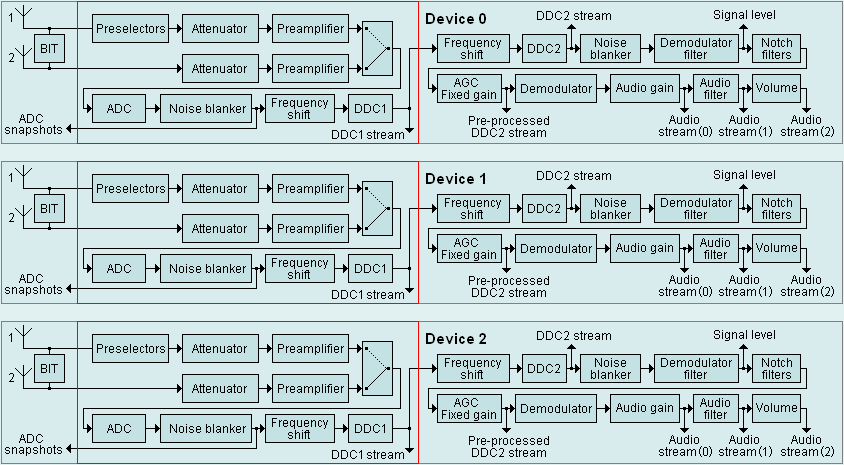
Simplified block diagram of the device set processing chain containing three interconnected G65DDC devices in coherent mode.
Phase-coherent parts of the device set are in the red rectangles.
The G65DDC API SDK is implemented as a dynamic library (G65DDCAPI.dll). It provides object-oriented and non-object-oriented interfaces to control a set of G65DDC devices in coherent mode. This document describes the object-oriented interface. The G65DDCAPI.dll library exports several functions which makes it possible to control G65DDC receivers in coherent mode.
The API is not fully thread-safe so preferably it should be used in single-threaded applications. It can be used in multi-threaded applications as well, but with some care: One set of G65DDC receivers can be controlled from a single user thread only.
A C/C++ header file G65DDCAPI.h is a part of the SDK. The API can be used by any 32-bit application under Microsoft Windows 8, Windows 10 and Windows 11 (including their 64-bit versions). The API can be used also by any 64-bit application but only under 64-bit versions of the supported operating systems.
The 'G65DDC device set' in coherent mode can consist of up to 16 interconnected G65DDC devices. DDC1 signals from all the G65DDC devices in such a set are phase-coherent. All other provided signals (ADC snapshots, DDC2 and audio) are not phase-coherent. Only one processing channel per device is available in coherent mode.
The G65DDCAPI.dll library can be loaded to the application by two Microsoft Windows API functions. The first one is LoadLibrary and
the other one is LoadLibraryEx. After the library is loaded, it is necessary to get addresses of the exported functions.
When the API is no longer required in the memory, the FreeLibrary function can be used to unload the API. Before the FreeLibrary is called, all the objects created using the CreateInstance function must be freed calling the Free method, otherwise the application may enter an unpredictable state.
The following source code shows how to load the API.
#include <stdio.h>
#include "G65DDCAPI.h"

G65DDC_CREATE_INSTANCE CreateInstance;
HMODULE hAPI;

void main(void)
{
    //Loading the API
    hAPI=LoadLibrary("G65DDCAPI.dll");

    if(hAPI!=NULL)
    {
        //Retrieving address of the CreateInstance function
        CreateInstance=(G65DDC_CREATE_INSTANCE)GetProcAddress(hAPI,"CreateInstance");

        //Here place code that uses the API

        FreeLibrary(hAPI);
    }
    else
    {
        //If the LoadLibrary fails
        printf("Failed to load G65DDCAPI.dll.\n");
    }
}
To enumerate available G65DDC device sets, the API provides an enumeration object. The object has to be created using the CreateInstance function. The following source code in C++ produces a list of device serial numbers for the available G65DDC device sets:
#include <stdio.h>
#include "G65DDCAPI.h"

void main(void)
{
 G65DDC_CREATE_INSTANCE CreateInstance;
 HMODULE hAPI;
 ICohG65DDCDeviceSetEnumerator *Enumerator=NULL;
 G65DDC_DEVICE_INFO *DevInfo;
 UINT32 Count;
 UINT32 DeviceSetCount,i,j;

    hAPI=LoadLibrary("G65DDCAPI.dll");

    if(hAPI!=NULL)
    {
        CreateInstance=(G65DDC_CREATE_INSTANCE)GetProcAddress(hAPI,"CreateInstance");

        if(CreateInstance(G65DDC_CLASS_ID_COH_DEVICE_SET_ENUMERATOR,(void**)&Enumerator))
        {
            Enumerator->Enumerate();

            DeviceSetCount=Enumerator->GetDeviceSetCount();

            if(DeviceSetCount!=0)
            {
                printf("Available G65DDC device set count=%d:\n",DeviceSetCount);

                for(i=0;i<Count;i++)
                {
                    printf("Device set %u:\n",i);

                    //retrieve number of devices in the device set
                    Count=0;
                    Enumerator->GetDeviceSetInfo(i,NULL,&Count);

                    printf("\tNumber of devices in the set: %u\n",Count);

                    DevInfo=new G65DDC_DEVICE_INFO[Count];
                    Enumerator->GetDeviceSetInfo(i,DevInfo,&Count);

                    for(j=0;j<Count;j++)
                    {
                        printf("\t\t%u: SN: %s\n",j,DevInfo[j].SerialNumber);
                    }

                    delete[] DevInfo;
                }
            }
            else
            {
                printf("No available G65DDC device set found.\n");
            }

            Enumerator->Free();
        }
        else
        {
            printf("Failed to create enumerator object. Error code=%08X\n",GetLastError());
        }

        FreeLibrary(hAPI);
    }
    else
    {
        printf("Failed to load G65DDCAPI.dll.\n");
    }

    printf("Press enter to exit\n");
    getchar();
}
The G65DDC device set has to be open before it can be controlled. The API provides an object to open and control the device set of interconnected G65DDC devices in coherent mode. This object has to be created using the CreateInstance function.
The following source code shows how to open the first available G65DDC device set.
#include <stdio.h>
#include "G65DDCAPI.h"


void main(void)
{
 G65DDC_CREATE_INSTANCE CreateInstance;
 HMODULE hAPI;
 ICohG65DDCDeviceSet *DeviceSet;

    //Loading the API
    hAPI=LoadLibrary("G65DDCAPI.dll");

    if(hAPI!=NULL)
    {
        //Retrieving address of the CreateInstance API functions
        CreateInstance=(G65DDC_CREATE_INSTANCE)GetProcAddress(hAPI,"CreateInstance");

        //Creating instance of the device object
        if(CreateInstance(G65DDC_CLASS_ID_COH_DEVICE_SET,(void**)&DeviceSet))
        {
            //Opening the first available G65DDC device set using predefined COH_G65DDC_OPEN_FIRST constant
            if(DeviceSet->Open(COH_G65DDC_OPEN_FIRST,0))
            {
                //Place code here that works with the open G65DDC device set

                //Closing device set
                DeviceSet->Close();
            }
            else
            {
                printf("Failed to open device set. Error code=%08X\n",GetLastError());
            }

            //Free the device set object
            DeviceSet->Free();
        }
        else
        {
            printf("Failed to create device set object. Error code=%08X\n",GetLastError());
        }

        FreeLibrary(hAPI);
    }
    else
    {
        //If the LoadLibrary fails
        printf("Failed to load G65DDCAPI.dll.\n");
    }
}
The following code demonstrates another way to open the first available G65DDC device set using the device set enumerator.
#include <stdio.h>
#include "G65DDCAPI.h"

void main(void)
{
 G65DDC_CREATE_INSTANCE CreateInstance;
 HMODULE hAPI;
 ICohG65DDCDeviceSetEnumerator *Enumerator=NULL;
 G65DDC_DEVICE_INFO *DevInfo;
 UINT32 Count;
 UINT32 DeviceSetCount;
 ICohG65DDCDeviceSet *DeviceSet;

    hAPI=LoadLibrary("G65DDCAPI.dll");

    if(hAPI!=NULL)
    {
        CreateInstance=(G65DDC_CREATE_INSTANCE)GetProcAddress(hAPI,"CreateInstance");

        if(CreateInstance(G65DDC_CLASS_ID_COH_DEVICE_SET_ENUMERATOR,(void**)&Enumerator))
        {
            Enumerator->Enumerate();

            DeviceSetCount=Enumerator->GetDeviceSetCount();

            if(DeviceSetCount!=0)
            {
                printf("Available G65DDC device set count=%d:\n",DeviceSetCount);

                //retrieve number of devices in the first device set
                Count=0;
                Enumerator->GetDeviceSetInfo(0,NULL,&Count);

                DevInfo=new G65DDC_DEVICE_INFO[Count];
                Enumerator->GetDeviceSetInfo(0,DevInfo,&Count);

                CreateInstance(G65DDC_CLASS_ID_COH_DEVICE_SET,(void**)&DeviceSet);

                if(DeviceSet->Open(DevInfo,Count))
                {
                    //Place code here that works with the open G65DDC device set

                    //Closing device set
                    DeviceSet->Close();
                }
                else
                {
                    printf("Failed to open device set. Error code=%08X\n",GetLastError());
                }

                DeviceSet->Free();

                delete[] DevInfo;
            }
            else
            {
                printf("No available G65DDC device set found.\n");
            }

            Enumerator->Free();
        }
        else
        {
            printf("Failed to create enumerator object. Error code=%08X\n",GetLastError());
        }

        FreeLibrary(hAPI);
    }
    else
    {
        printf("Failed to load G65DDCAPI.dll.\n");
    }

    printf("Press enter to exit\n");
    getchar();
}
Creates single object of the specified class and returns interface of the object.
C/C++ declaration
INT32 __stdcall CreateInstance(UINT32 ClassId,PVOID *Interface);
Address retrieval
G65DDC_CREATE_INSTANCE CreateInstance=(G65DDC_CREATE_INSTANCE)GetProcAddress(hAPI,"CreateInstance");
Parameters
ClassId[in] Specifies class identifier of the object to be created. This parameter must be one of the following:
Value Meaning G65DDC_CLASS_ID_COH_DEVICE_SET_ENUMERATOR Class identifier of the enumerator object. When the function finished successfully, ICohG65DDCDeviceSetEnumerator interface is stored to a pointer variable pointed to by the Interface parameter. G65DDC_CLASS_ID_COH_DEVICE_SET Class identifier of the device set object. When the function finished successfully, ICohG65DDCDeviceSet interface is stored to a pointer variable pointed to by the Interface parameter. Interface[out] Pointer to a variable that receives interface to newly created object of specified class. This parameter cannot be NULL.
Return value
If the method succeeds, the return value is non-zero.
If the method fails, the return value is zero. To get extended error information, call GetLastError.
Remarks
All of the objects created using CreateInstance must be freed, calling the Free method of their interfaces before the API is unloaded using the FreeLibrary function.
The CreateInstance function can be called in any user-thread. Returned interface can be used only in the same thread in which its object was created, otherwise the application can enter an unpredictable state.
ICohG65DDCDeviceSetEnumerator interface is the interface of the enumerator object that is created using the CreateInstance function and which provides an enumeration mechanism of available G65DDC devices sets. The enumerator does not discover G65DDC devices connected via their LAN interface.
Frees the enumerator object from memory. The interface is no longer usable.
C/C++ declaration
void __stdcall Free(void);
Parameters
None
Return value
None
Performs enumeration of available G65DDC devices sets in coherent mode.
C/C++ declaration
BOOL __stdcall Enumerate(void);
Parameters
None
Return value
If the method succeeds, the return value is non-zero.
If the method fails, the return value is zero. To get extended error information, call GetLastError.
Retrieves the number of available G65DDC device sets enumerated using the ICohG65DDCDeviceSetEnumerator::Enumerate method.
C/C++ declaration
UINT32 __stdcall GetDeviceSetCount(void);
Parameters
None
Return value
The method returns the number of available G65DDC device sets.
Retrieves information about the available G65DDC device set.
C/C++ declaration
BOOL __stdcall GetDeviceSetInfo(UINT32 DeviceSetIndex,G65DDC_DEVICE_INFO *DeviceInfos,UINT32 *DeviceInfosCount);
Parameters
DeviceSetIndex[in] Specifies the index of the device set. It can vary from zero to 'one less' than the value returned by the ICohG65DDCDeviceSetEnumerator::GetDeviceSetCount method.DeviceInfos[out] Pointer to an array of the G65DDC_DEVICE_INFO structures to be filled with information about the device set.The order of the device infos in the array corresponds to the hardware interconnect of physical G65DDC devices.DeviceInfosCount[in, out] Pointer to a variable that specifies size of the array (number of items in the array) pointed to by the DeviceInfos parameter. When the method returns, this variable contains the number of items copied to the DeviceInfos.If the array specified by DeviceInfos parameter is not large enough to hold information about all the devices in the device set, the method fails (GetLastError returns ERROR_INSUFFICIENT_BUFFER) and stores the required array size (number of items) in the variable pointed to by the DeviceInfosCount parameter.
Return value
If the method succeeds, the return value is non-zero.
If the method fails, the return value is zero. To get extended error information, call GetLastError.
The ICohG65DDCDeviceSet is an interface of the device set object that is created using the CreateInstance function. This interface allows control of the selected G65DDC device set in the coherent mode.
Frees the device set object from memory. The interface is no longer usable.
C/C++ declaration
void __stdcall Free(void);
Parameters
None
Return value
None
Opens a G65DDC device set and associates it with the device set object given by its interface pointer.
C/C++ declaration
BOOL __stdcall Open(G65DDC_DEVICE_INFO *DeviceInfos,UINT32 Count);
Parameters
DeviceInfos[in] Pointer to an array of G65DDC_DEVICE_INFO structures which contains information about all of the devices in the device set to be open. The number of items in the array is given by the Count parameter. The order of device info structures in the array has to correspond to the hardware interconnect of the G65DDC devices. Array of device info structures and its size can be obtained using the ICohG65DDCDeviceSetEnumerator. The example above shows how to achieve this.
It is possible to use one of the following predefined values instead of a pointer to the array:
Value Meaning COH_G65DDC_OPEN_FIRST This method opens the first available G65DDC device set. The Count parameter is ignored, the number of interconnected devices is determined automatically. COH_G65DDC_OPEN_DEMO This method opens a demo G65DDC device set. This allows developers to work with the API without physical G65DDC devices. The Count parameter specifies the number of demo receivers in the set and can vary from 1 to 16. Count[in] Specifies the number of items in the array pointed to by the DeviceInfos parameter.
Return value
If the method succeeds, the return value non-zero.
If the method fails, the return value is zero. To get extended error information, call GetLastError.
Remarks
The order of devices in the device set corresponds to the hardware interconnect of the G65DDC devices. Each individual device in the device set has its own constant index which does not change while the hardware G65DDC device interconnect remains the same. This index is used in some methods to access a specific device of the device set. The index of the first device is 0 (master device), the index of the second device is 1, etc..Closes the currently open G65DDC device set and all the devices of this set associated with the device set object and makes the object available for use with another G65DDC device set.
C/C++ declaration
BOOL __stdcall Close(void);
Parameters
None
Return value
If the method succeeds, the return value is non-zero.
If the method fails, the return value is zero. To get extended error information, call GetLastError.
Checks if a device set is associated with the device set object.
C/C++ declaration
BOOL __stdcall IsOpen(void);
Parameters
None
Return value
This method returns a non-zero value if a device is associated with the device object (using the ICohG65DDCDeviceSet::Open method) and it can be controlled using methods of the device set object interface.
The method returns zero if no device is associated with the device object.
Checks if all the devices in the device set are still connected to the computer.
C/C++ declaration
BOOL __stdcall IsConnected(BOOL *Connected);
Parameters
Connected[out] Pointer to a variable which receives the current connection status. If the received value is non-zero, all the devices in the given device set are still connected and available. If any device in the device set is disconnected, the received value is zero.
Return value
If the method succeeds, the return value is non-zero.
If the method fails, the return value is zero. To get extended error information, call GetLastError.
Remarks
If any device from the set is determined disconnected, the device set is no longer usable and should be closed using ICohG65DDCDeviceSet::Close method.
Retrieves the number of G65DDC devices in the device set.
C/C++ declaration
BOOL __stdcall GetDeviceCount(UINT32 *Count);
Parameters
Count[out] Pointer to a variable which receives the number of G65DDC devices in the device set. This parameter cannot be NULL.
Return value
If the method succeeds, the return value is non-zero.
If the method fails, the return value is zero. To get extended error information, call GetLastError.
Retrieves information about a single G65DDC device from the device set.
C/C++ declaration
BOOL __stdcall GetDeviceInfo(UINT32 DeviceIndex,G65DDC_DEVICE_INFO *Info);
Parameters
DeviceIndex[in] Specifies the index of the device in the device set. It can vary from zero to 'one less than the number of devices' in the device set. The order of the devices corresponds to the hardware interconnection of physical G65DDC devices.Info[out] Pointer to a G65DDC_DEVICE_INFO structure to be filled with information about the device. This parameter cannot be NULL.
Return value
If the method succeeds, the return value is non-zero.
If the method fails, the return value is zero. To get extended error information, call GetLastError.
Remarks
Use the ICohG65DDCDeviceSet::GetDeviceCount method to determine the number of devices in the device set.
Retrieves information about all of the G65DDC devices in the device set at once.
C/C++ declaration
BOOL __stdcall GetDeviceInfos(G65DDC_DEVICE_INFO *Infos,UINT32 *InfoCount);
Parameters
Infos[out] Pointer to an array of G65DDC_DEVICE_INFO structures to be filled with information about the device in the device set.The order of the device infos in the array corresponds to the hardware interconnect of physical G65DDC devices.InfoCount[in, out] Pointer to a variable that specifies the size of the array (number of items in the array) pointed to by the Infos parameter. When the method returns, this variable contains the number of items copied to Infos.If the array specified by Infos parameter is not large enough to hold information about all the devices in the device set, the method fails (GetLastError returns ERROR_INSUFFICIENT_BUFFER) and stores the required array size (number of items) in the variable pointed to by the InfoCount parameter.
Return value
If the method succeeds, the return value is non-zero.
If the method fails, the return value is zero. To get extended error information, call GetLastError.
Remarks
Use the ICohG65DDCDeviceSet::GetDeviceCount method to determine the number of devices in the device set.
Sets the front panel LED flashing mode of the specified G65DDCe device in the device set.
C/C++ declaration
BOOL __stdcall SetLED(UINT32 DeviceIndex,UINT32 LEDMode);
Parameters
DeviceIndex[in] Specifies the index of the device in the device set. It can vary from zero to 'one less than number of devices' in the device set.LEDMode[in] Specifies the front panel LED flashing mode, which can be one of the following:
Value Meaning G65DDC_FRONT_PANEL_LED_MODE_DIAG Diagnostic flashing. G65DDC_FRONT_PANEL_LED_MODE_ON Always on. G65DDC_FRONT_PANEL_LED_MODE_OFF Always off.
Return value
If the method succeeds, the return value is non-zero.
If the method fails, the return value is zero. To get extended error information, call GetLastError.
Remarks
Use the ICohG65DDCDeviceSet::GetLED method to determine the current flashing mode of the front panel LED.
A complete list of the diagnostic flashing patterns and their meaning is as follows:
No. Pattern Description Mode 1
Off No power 2
Fading No connection to computer 3
Two short flashes USB or LAN client connected, radio off 4
One short flash followed by a long one USB or LAN connected, radio on, ready 5
Two short flashes followed by a long one USB connected, driver not installed 6
Three short flashes USB or LAN connected, driver installed, application not running
Determines the current flashing mode of G65DDCe device's front panel LED.
C/C++ declaration
BOOL __stdcall GetLED(UINT32 DeviceIndex,UINT32 *LEDMode);
Parameters
DeviceIndex[in] Specifies the index of the device in the device set. It can vary from zero to 'one less than number of devices' in the device set.LEDMode[out] Pointer to a variable which receives the current flashing mode of device's front panel LED. For a list of possible values, see ICohG65DDCDeviceSet::SetLED. This parameter cannot be NULL.
Return value
If the method succeeds, the return value is non-zero.
If the method fails, the return value is zero. To get extended error information, call GetLastError.
Turns on or off all of the G65DDC devices in the device set.
C/C++ declaration
BOOL __stdcall SetPower(BOOL Power);
Parameters
Power[in] Specifies whether to turn on or off the devices. If this parameter is non-zero all of the devices in the device set are turned on, if it is zero then all of the devices are turned off.
Return value
If the method succeeds, the return value is non-zero.
If the method fails, the return value is zero. To get extended error information, call GetLastError. To get additional information about the failure, check the state of all of the devices in the set using the ICohG65DDCDeviceSet::GetDeviceState method.
Remarks
If ICohG65DDCDeviceSet::SetPower turns the devices off, all the running streams are stopped.
Use the ICohG65DDCDeviceSet::GetPower method to determine the current power state of devices in the device set.
ICohG65DDCDeviceSet::SetPower fails if some parts of the multichannel coherent system are not properly interconnected or improper cables are used for interconnection.
The GetPower method determines whether the devices are turned on or off.
C/C++ declaration
BOOL __stdcall GetPower(BOOL *Power);
Parameters
Power[out] Pointer to a variable which receives the current power state of the device set. If it is non-zero, the devices are turned on. If it is zero the devices are turned off. This parameter cannot be NULL.
Return value
If the method succeeds, the return value is non-zero.
If the method fails, the return value is zero. To get extended error information, call GetLastError.
Retrieves the current state of the G65DDC device in the device set, like internal temperatures, error state, data transfer counters.
C/C++ declaration
BOOL __stdcall GetDeviceState(UINT32 DeviceIndex,G65DDC_DEVICE_STATE *State);
Parameters
DeviceIndex[in] Specifies the index of the device in the device set. It can vary from zero to 'one less than number of devices' in the device set.State[out] Pointer to a G65DDC_DEVICE_STATE structure to be filled with the current device state. This parameter cannot be NULL.
Return value
If the method succeeds, the return value is non-zero.
If the method fails, the return value is zero. To get extended error information, call GetLastError.
Enables or disables the test signal at the receiver's input, which allows testing of the entire signal and processing path.
C/C++ declaration
BOOL __stdcall SetBuiltInTest(UINT32 DeviceIndex,BOOL Enabled);
Parameters
DeviceIndex[in] Specifies the index of the device in the device set. It can vary from zero to 'one less than number of devices' in the device set.Enabled[in] Specifies whether to enable or disable the built-in test. If this parameter is non-zero, the test signal is enabled. If the parameter is zero, the test signal is disabled.Test signal parameters:
Range Frequency Level 1 65 MHz ± 5 MHz -40 dBm ± 3 dB 2 152 MHz ± 5 MHz -34 dBm ± 3 dB
Return value
If the method succeeds, the return value is non-zero.
If the method fails, the return value is zero. To get extended error information, call GetLastError.
Retrieves information about whether the test signal is enabled or not.
C/C++ declaration
BOOL __stdcall GetBuiltInTest(UINT32 DeviceIndex,BOOL *Enabled);
Parameters
DeviceIndex[in] Specifies the index of the device in the device set. It can vary from zero to 'one less than number of devices' in the device set.Enabled[out] Pointer to a variable which receives information about the test signal state. If it is non-zero, test signal is enabled, if it is zero, test signal is not enabled. This parameter cannot be NULL.
Return value
If the method succeeds, the return value is non-zero.
If the method fails, the return value is zero. To get extended error information, call GetLastError.
Sets the RF input attenuator.
C/C++ declaration
BOOL __stdcall SetAttenuator(UINT32 Attenuator);
Parameters
Attenuator[in] The value that specifies attenuation level in dB. Possible values are: 0, 3, 6, 9, 12, 15, 18, 21. If the value is not from the list, the ICohG65DDCDeviceSet::SetAttenuator method rounds the value to the nearest lower one.
Return value
If the method succeeds, the return value is non-zero.
If the method fails, the return value is zero. To get extended error information, call GetLastError.
Remarks
Use the ICohG65DDCDeviceSet::GetAttenuator method to determine the current setting of the attenuator.
If the receiver which is open (in the given device set) is a part of the multichannel coherent system in Extended Topology Configuration (ETC, see ICohG65DDCDeviceSet::SetConfiguration), then the ICohG65DDCDeviceSet::SetAttenuator method with the same value of the Attenuator parameter has to be called on all of the receivers in this multichannel coherent system.
Retrieves the current setting of the RF input attenuator.
C/C++ declaration
BOOL __stdcall GetAttenuator(UINT32 *Attenuator);
Parameters
Attenuator[out] Pointer to a variable which receives the current attenuation level. This parameter cannot be NULL.
Return value
If the method succeeds, the return value is non-zero.
If the method fails, the return value is zero. To get extended error information, call GetLastError.
Controls the band pass filter at the RF input in the first range.
C/C++ declaration
BOOL __stdcall SetPreselectors(UINT32 Low,UINT32 High);
Parameters
Low[in] Specifies the cut-off low frequency of the filter in Hz. Possible values are: 0, 850000, 2400000, 5400000, 11800000. If the value is not from this list, the method rounds it to the nearest one.High[in] Specifies the cut-off high frequency of the filter in Hz. Possible values are: 3100000, 5400000, 11800000, 23300000, 88000000. If the value is not from this list, the method rounds it to the nearest one.
Return value
If the method succeeds, the return value is non-zero.
If the method fails, the return value is zero. To get extended error information, call GetLastError.
Remarks
The value of the Low parameter must not be higher than value of the High parameter, otherwise the method fails.
Use the ICohG65DDCDeviceSet::GetPreselectors method to determine the current setting of the preselectors.
If the receiver which is open (in the given device set) is part of the multichannel coherent system in Extended Topology Configuration (ETC, see ICohG65DDCDeviceSet::SetConfiguration), then the ICohG65DDCDeviceSet::SetPreselectors method with the same values of the Low and High parameters has to be called on all of the receivers in this multichannel coherent system.
Retrieves the current setting of the RF input band pass filter.
C/C++ declaration
BOOL __stdcall GetPreselectors(UINT32 *Low,UINT32 *High);
Parameters
Low[out] Pointer to a variable which receives the current cut-off low frequency of the filter in Hz. This parameter can be NULL if the application does not require this information.High[out] Pointer to a variable which receives the current cut-off high frequency of the filter in Hz. This parameter can be NULL if the application does not require this information.
Return value
If the method succeeds, the return value is non-zero.
If the method fails, the return value is zero. To get extended error information, call GetLastError.
Enables or disables the RF input preamplifier.
C/C++ declaration
BOOL __stdcall SetPreamplifier(BOOL Preamp);
Parameters
Preamp[in] Specifies whether to enable or disable the RF preamplifier. If this parameter is non-zero, the preamplifier is enabled. If the parameter is zero, the preamplifier is disabled.
Return value
If the method succeeds, the return value is non-zero.
If the method fails, the return value is zero. To get extended error information, call GetLastError.
Remarks
Use the ICohG65DDCDeviceSet::GetPreamplifier method to determine the current state of the preamplifier.
If the receiver which is open (in the given device set) is a part of the multichannel coherent system in Extended Topology Configuration (ETC, see ICohG65DDCDeviceSet:::SetConfiguration), then the ICohG65DDCDeviceSet::SetPreamplifier method with the same value of the Preamp parameter has to be called on for all of the receivers in this multichannel coherent system.
Retrieves the current state of the RF input preamplifier.
C/C++ declaration
BOOL __stdcall GetPreamplifier(BOOL *Preamp);
Parameters
Preamp[out] Pointer to a variable which receives the current state of the preamplifier. The value is non-zero if the preamplifier is enabled and zero if it is disabled. This parameter cannot be NULL.
Return value
If the method succeeds, the return value is non-zero.
If the method fails, the return value is zero. To get extended error information, call GetLastError.
Enables or disables frequency spectrum inversion.
C/C++ declaration
BOOL __stdcall SetInverted(BOOL Inverted);
Parameters
Inverted[in] Specifies whether to enable or disable frequency spectrum inversion. If this parameter is non-zero, IF spectrum is inverted.
Return value
If the method succeeds, the return value is non-zero.
If the method fails, the return value is zero. To get extended error information, call GetLastError.
Retrieves the current frequency spectrum inversion setting.
C/C++ declaration
BOOL __stdcall GetInverted(BOOL *Inverted);
Parameters
Inverted[out] Pointer to a variable which receives a non-zero value if the frequency spectrum inversion is enabled, and zero if the inversion is disabled. This parameter cannot be NULL.
Return value
If the method succeeds, the return value is non-zero.
If the method fails, the return value is zero. To get extended error information, call GetLastError.
Switches the active receiver's RF input between range 1 and range 2.
C/C++ declaration
BOOL __stdcall SetRange(UINT32 Range);
Parameters
Range[in] Specifies which range will be active. The value can be G65DDC_RANGE_1 for range 1, or G65DDC_RANGE_2 for range 2.
Return value
If the method succeeds, the return value is non-zero.
If the method fails, the return value is zero. To get extended error information, call GetLastError. To get additional information about the failure, check state of all the devices in the set using the ICohG65DDCDeviceSet::GetDeviceState method.
Remarks
If the receiver which is open (in the given device set) is a part of the multichannel coherent system in Extended Topology Configuration (ETC, see ICohG65DDCDeviceSet::SetConfiguration), then the ICohG65DDCDeviceSet::SetRange method with the same value of the Range parameter has to be called on all of the receivers in this multichannel coherent system. This is to prepare all of the receivers, and then the operation has to be completed by calling the ICohG65DDCDeviceSet::Trigger method on the synchronization master receiver.
Retrieves information regarding which range is active.
C/C++ declaration
BOOL __stdcall GetRange(UINT32 *Range);
Parameters
Range[out] Pointer to a variable which receives G65DDC_RANGE_1 if range 1 is active, or G65DDC_RANGE_2 if range 2 is active. This parameter cannot be NULL.
Return value
If the method succeeds, the return value is non-zero.
If the method fails, the return value is zero. To get extended error information, call GetLastError.
Enables or disables the noise blanker on the ADC stream.
C/C++ declaration
BOOL __stdcall SetADCNoiseBlanker(BOOL Enabled);
Parameters
Enabled[in] Specifies whether to enable or disable the noise blanker. If this parameter is non-zero, the noise blanker is enabled. If the parameter is zero, the noise blanker is disabled.
Return value
If the method succeeds, the return value is non-zero.
If the method fails, the return value is zero. To get extended error information, call GetLastError.
Remarks
Use the ICohG65DDCDeviceSet::GetADCNoiseBlanker method to determine the current state of the noise blanker.
If the receiver which is open (in the given device set) is a part of the multichannel coherent system in Extended Topology Configuration (ETC, see ICohG65DDCDeviceSet::SetConfiguration), then the ICohG65DDCDeviceSet::SetADCNoiseBlanker method with the same value of the Enabled parameter has to be called on all of the receivers in this multichannel coherent system.
Retrieves the current ADC noise blanker state.
C/C++ declaration
BOOL __stdcall GetADCNoiseBlanker(BOOL *Enabled);
Parameters
Enabled[out] Pointer to a variable which receives the current state of the noise blanker. The value is non-zero if noise blanker is enabled and zero if it is disabled. This parameter cannot be NULL.
Return value
If the method succeeds, the return value is non-zero.
If the method fails, the return value is zero. To get extended error information, call GetLastError.
Specifies the ADC noise blanker threshold.
C/C++ declaration
BOOL __stdcall SetADCNoiseBlankerThreshold(WORD Threshold);
Parameters
Threshold[in] Specifies the maximum acceptable input signal. The maximum possible value of threshold is 32767, in this case the noise blanker has no effect even if it is enabled using the ICohG65DDCDeviceSet::SetADCNoiseBlanker method.
Return value
If the method succeeds, the return value is non-zero.
If the method fails, the return value is zero. To get extended error information, call GetLastError.
Remarks
Use the ICohG65DDCDeviceSet::GetADCNoiseBlankerThreshold method to retrieve the current threshold of the noise blanker.
Determines the ADC noise blanker threshold.
C/C++ declaration
BOOL __stdcall GetADCNoiseBlankerThreshold(WORD *Threshold);
Parameters
Threshold[out] Pointer to a variable which receives the threshold of ADC noise blanker. This parameter cannot be NULL.
Return value
If the method succeeds, the return value is non-zero.
If the method fails, the return value is zero. To get extended error information, call GetLastError.
Starts the sending of ADC snapshots from a specific device of the device set.
C/C++ declaration
BOOL __stdcall StartADCSnapshots(UINT32 DeviceIndex,WORD Interval,UINT32 SamplesPerSnapshot);
Parameters
DeviceIndex[in] Specifies the index of the device in the device set. It can vary from zero to 'one less than number of devices' in the device set.Period[in] Specifies the time interval in milliseconds for how often the ADC snapshots are sent to the ICohG65DDCDeviceSetCallback::CohG65DDC_ADCSnapshotCallback callback.SamplesPerSnapshot[in] Specifies the number of 16-bit samples per single ADC snapshot. In other words, it is the number of samples per buffer passed to the ICohG65DDCDeviceSetCallback::CohG65DDC_ADCSnapshotCallback callback. It can be one of the following:
Value Number of samples per snapshot G65DDC_ADC_SAMPLES_PER_SNAPSHOT_64K 65536 G65DDC_ADC_SAMPLES_PER_SNAPSHOT_128K 131072 G65DDC_ADC_SAMPLES_PER_SNAPSHOT_256K 262144
Return value
If the method succeeds, the return value is non-zero.
If the method fails, the return value is zero. To get extended error information, call GetLastError.
Remarks
The G65DDC device set has to be turned on using the ICohG65DDCDeviceSet::SetPower method before use of ICohG65DDCDeviceSet::StartADCSnapshots, otherwise the ICohG65DDCDeviceSet::StartADCSnapshots method fails.
Stops the sending of ADC snapshots from a specific device of the device set.
C/C++ declaration
BOOL __stdcall StopADCSnapshots(UINT32 DeviceIndex,);
Parameters
DeviceIndex[in] Specifies the index of the device in the device set. It can vary from zero to 'one less than number of devices' in the device set.
Return value
If the method succeeds, the return value is non-zero.
If the method fails, the return value is zero. To get extended error information, call GetLastError.
Remarks
The ICohG65DDCDeviceSetCallback::CohG65DDC_ADCSnapshotCallback callback is not called after ICohG65DDCDeviceSet::StopADCSnapshots returns.
Retrieves information about the DDC format.
C/C++ declaration
BOOL __stdcall GetDDCInfo(UINT32 DDCTypeIndex,G65DDC_DDC_INFO *DDCInfo);
Parameters
DDCTypeIndex[in] Specifies the index of DDC type. For more information, see remarks.DDCInfo[out] Pointer to a G65DDC_DDC_INFO structure to be filled with information about the DDC type.
Return value
If the method succeeds, the return value is non-zero.
If the method fails, the return value is zero. To get extended error information, call GetLastError.
Remarks
Use the ICohG65DDCDeviceSet::GetDDC1Count method to determine the number of possible DDC types of DDC1. In this case the DDCTypeIndex parameter can vary from zero to 'one less' than the number determined by the ICohG65DDCDeviceSet::GetDDC1Count.
Use the ICohG65DDCDeviceSet::GetDDC1 method to determine the current DDC type index of DDC1 and the ICohG65DDCDeviceSet::GetDDC2 method to determine current DDC type of DDC2.
Retrieves the number of DDC types supported by DDC1.
C/C++ declaration
BOOL __stdcall GetDDC1Count(UINT32 *Count);
Parameters
Count[out] Pointer to a variable which receives the number of DDC types supported by the DDC1. This parameter cannot be NULL.
Return value
If the method succeeds, the return value is non-zero.
If the method fails, the return value is zero. To get extended error information, call GetLastError.
Sets current DDC type of DDC1.
C/C++ declaration
BOOL __stdcall SetDDC1(UINT32 DDCTypeIndex);
Parameters
DDCTypeIndex[in] Specifies the index of DDC type to be used in DDC1. It can vary from zero to 'one less than number of DDC types' of the DDC1.
Return value
If the method succeeds, the return value is non-zero.
If the method fails, the return value is zero. To get extended error information, call GetLastError.
Remarks
Use the ICohG65DDCDeviceSet::GetDDC1Count method to determine the number of possible DDC types of DDC1. The DDCTypeIndex parameter can vary from zero to 'one less' than the number determined by ICohG65DDCDeviceSet::GetDDC1Count method.
DDC1 streaming must not run when calling ICohG65DDCDeviceSet::SetDDC1. In other words, DDC1 streaming which is started using the ICohG65DDCDeviceSet::StartDDC1 method has to be stopped using the ICohG65DDCDeviceSet::StopDDC1 method before calling of ICohG65DDCDeviceSet::SetDDC1, otherwise ICohG65DDCDeviceSet::SetDDC1 fails. The ICohG65DDCDeviceSet::SetDDC1 method does not start and stop DDC1 streaming, it just changes the DDC type of DDC1.
Calling of ICohG65DDCDeviceSet::SetDDC1 can change the current DDC type of DDC2 and current bandwidth of demodulator filter, so it is useful to call the ICohG65DDCDeviceSet::GetDDC2 and ICohG65DDCDeviceSet::GetDemodulatorFilterBandwidth methods immediately after ICohG65DDCDeviceSet::SetDDC1 to determine the current DDC type of DDC2 and current bandwidth of the demodulator filter.
Use the ICohG65DDCDeviceSet::GetDDC1 method to determine the current DDC type of the DDC1.
If the receiver which is open (in the given device set) is a part of the multichannel coherent system in Extended Topology Configuration (ETC, see ICohG65DDCDeviceSet::SetConfiguration), then the ICohG65DDCDeviceSet::SetDDC1 method with the same value of the DDCTypeIndex parameter has to be called on all of the receivers in this multichannel coherent system before DDC1 streaming is started using the ICohG65DDCDeviceSet::StartDDC1 method.
Retrieves information about the current DDC type of the DDC1.
C/C++ declaration
BOOL __stdcall GetDDC1(UINT32 *DDCTypeIndex,G65DDC_DDC_INFO *DDCInfo);
Parameters
DDCTypeIndex[out] Pointer to a variable which receives the index of current DDC type of the DDC1. This parameter can be NULL if the application does not require this information.DDCInfo[out] Pointer to a G65DDC_DDC_INFO structure to be filled with information about the current DDC type of the DDC1. This parameter can be NULL if the application does not require this information.
Return value
If the method succeeds, the return value is non-zero.
If the method fails, the return value is zero. To get extended error information, call GetLastError.
Remarks
Returned DDCTypeIndex can be passed to the ICohG65DDCDeviceSet::GetDDCInfo method.
Sets the DDC1 center frequency.
C/C++ declaration
BOOL __stdcall SetDDC1Frequency(INT32 Frequency);
Parameters
Frequency[in] Specifies the new center frequency of the DDC1 in Hz.
Return value
If the method succeeds, the return value is non-zero.
If the method fails, the return value is zero. To get extended error information, call GetLastError. To get additional information about the failure, check state of all the devices in the set using the ICohG65DDCDeviceSet::GetDeviceState method.
Remarks
Changing of DDC1 frequency causes a change of the absolute frequency of the DDC2 and demodulator in each device in the set.
Use the ICohG65DDCDeviceSet::GetDDC1Frequency method to determine the current center frequency of DDC1.
If the receiver which is open (in the given device set) is a part of the multichannel coherent system in Extended Topology Configuration (ETC, see ICohG65DDCDeviceSet::SetConfiguration), then the ICohG65DDCDeviceSet::SetDDC1Frequency method with the same value of the Frequency parameter has to be called on all of the receivers in this multichannel coherent system. This is to prepare all of the receivers, and then the operation has to be completed by calling the ICohG65DDCDeviceSet::Trigger method on the synchronization master receiver.
Retrieves the current center frequency of DDC1.
C/C++ declaration
BOOL __stdcall GetDDC1Frequency(INT32 *Frequency);
Parameters
Frequency[out] Pointer to a variable which receives the current center frequency of DDC1 in Hz. This parameter cannot be NULL.
Return value
If the method succeeds, the return value is non-zero.
If the method fails, the return value is zero. To get extended error information, call GetLastError.
Sets the phase shift of the DDC1 signal for a specific device in the device set.
C/C++ declaration
BOOL __stdcall SetDDC1PhaseShift(UINT32 DeviceIndex,double PhaseShift);
Parameters
DeviceIndex[in] Specifies index index of the device in the device set. It can vary from zero to 'one less than number of devices' in the device set.PhaseShift[in] Specifies the new phase shift of the DDC1 signal in degrees at the current DDC1 center frequency. It can vary from -180 to +180 degrees.
Return value
If the method succeeds, the return value is non-zero.
If the method fails, the return value is zero. To get extended error information, call GetLastError.
Remarks
It can be used for compensation of 'small length differences' of cables used for the coherent clock or at the receiver RF inputs.
Use the ICohG65DDCDeviceSet::GetDDC1PhaseShift method to retrieve the current phase shift of the DDC1 signal.
Retrieves the current phase shift of the DDC1 signal for the specific device in the device set.
C/C++ declaration
BOOL __stdcall GetDDC1PhaseShift(UINT32 DeviceIndex,double *PhaseShift);
Parameters
DeviceIndex[in] Specifies the index of the device in the device set. It can vary from zero to 'one less than number of devices' in the device set.PhaseShift[out] Pointer to a variable which receives the current phase shift of the DDC1 signal in degrees. This parameter cannot be NULL.
Return value
If the method succeeds, the return value is non-zero.
If the method fails, the return value is zero. To get extended error information, call GetLastError.
Starts coherent DDC1 streaming on all of the devices in the set simultaneously.
C/C++ declaration
BOOL __stdcall StartDDC1(UINT32 SampleSetsPerBuffer);
Parameters
SampleSetsPerBuffer[in] Specifies the number of I/Q sample sets in each buffer passed to the ICohG65DDCDeviceSetCallback::CohG65DDC_DDC1StreamCallback callback. If the current DDC1 type index (specified by the ICohG65DDCDeviceSet::SetDDC1 method) is less than or equal to 24 (DDC1 bandwidth <= 5 MHz) the value of the SampleSetsPerBuffer has to be a multiple of 64. If the current the DDC1 type index is greater than 24 (DDC1 bandwidth > 5 MHz), the SampleSetsPerBuffer has to be a multiple of 1024. If it is zero, the ICohG65DDCDeviceSet::StartDDC1 method fails.
Return value
If the method succeeds, the return value is non-zero.
If the method fails, the return value is zero. To get extended error information, call GetLastError. To get additional information about the failure, check state of all the devices in the set using the ICohG65DDCDeviceSet::GetDeviceState method.
Remarks
The G65DDC devices have to be turned on using the ICohG65DDCDeviceSet::SetPower method before ICohG65DDCDeviceSet::StartDDC1 is used. Otherwise ICohG65DDCDeviceSet::StartDDC1 fails.
If the DDC1 streaming is already running before use of ICohG65DDCDeviceSet::StartDDC1, ICohG65DDCDeviceSet::StartDDC1 fails.
Use the ICohG65DDCDeviceSet::StopDDC1 method to stop DDC1 streaming.
Decreasing the value of the SampleSetsPerBuffer parameter decreases latency and may increase CPU usage. Increasing the value of the SampleSetsPerBuffer parameter increases latency and may decrease CPU usage.
If the receiver which is open (in the given device set) is a part of the multichannel coherent system in Extended Topology Configuration (ETC, see ICohG65DDCDeviceSet::SetConfiguration), then the ICohG65DDCDeviceSet::StartDDC1 method with the same value of the SampleSetsPerBuffer parameter has to be called on all of the receivers in this multichannel coherent system. This is to prepare all the receivers and then the operation has to be completed by calling the ICohG65DDCDeviceSet::Trigger method on the synchronization master receiver.
Stops DDC1 streaming on all of the devices of the device set.
C/C++ declaration
BOOL __stdcall StopDDC1(void);
Parameters
None
Return value
If the method succeeds, the return value is non-zero.
If the method fails, the return value is zero. To get extended error information, call GetLastError.
Remarks
The ICohG65DDCDeviceSet::StopDDC1 method stops all of the streaming beyond the DDC1 in the processing chain (DDC2 and audio streaming in all the devices in the set).
The ICohG65DDCDeviceSetCallback::CohG65DDC_DDC1StreamCallback callback is not called after ICohG65DDCDeviceSet::StopDDC1 returns.
Retrieves the number of DDC types supported by DDC2.
C/C++ declaration
BOOL __stdcall GetDDC2Count(UINT32 *Count);
Parameters
Count[out] Pointer to a variable which receives the number of DDC types supported by the DDC2. This parameter cannot be NULL.
Return value
If the method succeeds, the return value is non-zero.
If the method fails, the return value is zero. To get extended error information, call GetLastError.
Remarks
The maximum number of DDC types supported by the DDC2 channel is determined by the MaxDDC2TypeCount member of the G65DDC_DEVICE_INFO structure but it cannot be greater than the current DDC type index of the DDC1 channel + 1.
Sets the current DDC type of DDC2 for the specific device in the device set.
C/C++ declaration
BOOL __stdcall SetDDC2(UINT32 DeviceIndex,UINT32 DDCTypeIndex);
Parameters
DeviceIndex[in] Specifies the index of the device in the device set. It can vary from zero to 'one less than number of devices' in the device set.DDCTypeIndex[in] Specifies the index of the DDC type to be used in DDC2.
Return value
If the method succeeds, the return value is non-zero.
If the method fails, the return value is zero. To get extended error information, call GetLastError.
Remarks
Use the ICohG65DDCDeviceSet::GetDDC2Count method to determine the number of possible DDC types of DDC2 for the given channel. The DDCTypeIndex parameter can vary from zero to one less than the number determined by ICohG65DDCDeviceSet::GetDDC2Count.
DDC2 streaming must not run when calling ICohG65DDCDeviceSet::SetDDC2. In other words, DDC2 streaming that is started using the ICohG65DDCDeviceSet::StartDDC2 method has to be stopped using the ICohG65DDCDeviceSet::StopDDC2 method before calling of ICohG65DDCDeviceSet::SetDDC2, otherwise ICohG65DDCDeviceSet::SetDDC2 fails. The ICohG65DDCDeviceSet::SetDDC2 method does not start and stop DDC2 streaming, it just changes the DDC type of DDC2.
Calling of ICohG65DDCDeviceSet::SetDDC2 can change the current bandwidth of the demodulator filter, therefore it is useful to call the ICohG65DDCDeviceSet::GetDemodulatorFilterBandwidth method immediately after ICohG65DDCDeviceSet::SetDDC2 to determine the current bandwidth of the demodulator filter.
Use the ICohG65DDCDeviceSet::GetDDC2 method to determine the current DDC type of the DDC2.
Retrieves information about the current DDC type of the DDC2 for the specified device in the device set.
C/C++ declaration
BOOL __stdcall GetDDC2(UINT32 DeviceIndex,UINT32 *DDCTypeIndex,G65DDC_DDC_INFO *DDCInfo);
Parameters
DeviceIndex[in] Specifies the index of the device in the device set. It can vary from zero to 'one less than number of devices' in the device set.DDCTypeIndex[out] Pointer to a variable which receives the index of the current DDC type of the DDC2. This parameter can be NULL if the application does not require this information.DDCInfo[out] Pointer to a G65DDC_DDC_INFO structure to be filled with information about the current DDC type of the DDC2. This parameter can be NULL if the application does not require this information.
Return value
If the method succeeds, the return value is non-zero.
If the method fails, the return value is zero. To get extended error information, call GetLastError.
Remarks
The BitsPerSample member of the G65DDC_DDC_INFO structure is not used and it can be ignored for DDC2. I and Q samples in buffers passed to the ICohG65DDCDeviceSetCallback::CohG65DDC_DDC2StreamCallback and ICohG65DDCDeviceSetCallback::CohG65DDC_DDC2PreprocessedStreamCallback DDC2 callbacks are always in IEEE float (32-bit, little endian) format.
Returned DDCTypeIndex can be passed to the ICohG65DDCDeviceSet::GetDDCInfo method.
Sets the relative center frequency of DDC2 for the specified device of the device set.
C/C++ declaration
BOOL __stdcall SetDDC2Frequency(UINT32 DeviceIndex,INT32 Frequency);
Parameters
DeviceIndex[in] Specifies the index of the device in the device set. It can vary from zero to 'one less than number of devices' in the device set.Frequency[in] Specifies the new center frequency of DDC2 in Hz.
Return value
If the method succeeds, the return value is non-zero.
If the method fails, the return value is zero. To get extended error information, call GetLastError.
Remarks
The value of the Frequency parameter is the center frequency of the DDC2 relative to center of the DDC1. The value can be negative.
The absolute frequency of the DDC2 is given by the following formula:
faDDC2 = faDDC1 + frDDC2
Where faDDC2 is the absolute center frequency of DDC2, faDDC1 is the absolute center frequency of the DDC1 in Hz (set using the ICohG65DDCDeviceSet::SetDDC1Frequency method) and frDDC2 is the relative center frequency of DDC2 in Hz (set using ICohG65DDCDeviceSet::SetDDC2Frequency).
A change of center frequency of the DDC1 channel causes a change of absolute frequency of the DDC2 channels (and its demodulators) connected to the given DDC1 channel.
Use the ICohG65DDCDeviceSet::GetDDC2Frequency method to determine the current relative center frequency of the DDC2.
The following example shows three methods of how it is possible to set the absolute DDC2 center frequency of the first device (DeviceIndex = 0) to 11.01 MHz:
ICohG65DDCDeviceSet *DeviceSet; //Interface of the G65DDC device set object, created using CreateInstance function

//1. method
DeviceSet->SetRange(G65DDC_RANGE_1); //Set active receiver's input to range 1 (0 - 88 MHz)
DeviceSet->SetDDC1Frequency(11010000);
DeviceSet->SetDDC2Frequency(0,0);

//2. method, can be used if the bandwidth of DDC2 is less than the bandwidth of DDC1
DeviceSet->SetRange(G65DDC_RANGE_1);
DeviceSet->SetDDC1Frequency(11000000);
DeviceSet->SetDDC2Frequency(0,10000);

//3. method, can be used if the bandwidth of DDC2 is less than the bandwidth of DDC1
DeviceSet->SetRange(G65DDC_RANGE_1);
DeviceSet->SetDDC1Frequency(11020000);
DeviceSet->SetDDC2Frequency(0,-10000);
Retrieves the current relative DDC2 center frequency of the specified device in the device set.
C/C++ declaration
BOOL __stdcall GetDDC2Frequency(UINT32 DeviceIndex,INT32 *Frequency);
Parameters
DeviceIndex[in] Specifies the index of the device in the device set. It can vary from zero to 'one less than number of devices' in the device set.Frequency[out] Pointer to a variable which receives the current relative center frequency of DDC2 in Hz. The returned value can be negative. See remarks of the ICohG65DDCDeviceSet::SetDDC2Frequency for information how to calculate the absolute center frequency of DDC2. This parameter cannot be NULL.
Return value
If the method succeeds, the return value is non-zero.
If the method fails, the return value is zero. To get extended error information, call GetLastError.
Starts DDC2 streaming on the specified device.
C/C++ declaration
BOOL __stdcall StartDDC2(UINT32 DeviceIndex,UINT32 SampleSetsPerBuffer);
Parameters
DeviceIndex[in] Specifies the index of the device in the device set. It can vary from zero to 'one less than number of devices' in the device set.SampleSetsPerBuffer[in] Specifies the number of I/Q sample sets in each buffer passed to the ICohG65DDCDeviceSetCallback::CohG65DDC_DDC2StreamCallback and ICohG65DDCDeviceSetCallback::CohG65DDC_DDC2PreprocessedStreamCallback callbacks. The value has to be a multiple of 64 greater than zero. If it is zero, the ICohG65DDCDeviceSet::StartDDC2 method fails. If it is not a multiple of 64, the method rounds it up to nearest multiple of 64.
Return value
If the method succeeds, the return value is non-zero.
If the method fails, the return value is zero. To get extended error information, call GetLastError.
Remarks
Before ICohG65DDCDeviceSet::StartDDC2 is used, the devices of the device set have to be turned on using the ICohG65DDCDeviceSet::SetPower method and DDC1 streaming has to be started using the ICohG65DDCDeviceSet::StartDDC1 method, otherwise ICohG65DDCDeviceSet::StartDDC2 fails.
If the DDC2 streaming for a given device is already running, ICohG65DDCDeviceSet::StartDDC2 fails.
Use the ICohG65DDCDeviceSet::StopDDC2 method to stop DDC2 streaming.
Decreasing the value of the SampleSetsPerBuffer parameter decreases latency and may increase CPU usage. Increasing the value of the SampleSetsPerBuffer parameter increases latency and may decrease CPU usage.
Stops DDC2 streaming on the specified device.
C/C++ declaration
BOOL __stdcall StopDDC2(UINT32 DeviceIndex);
Parameters
DeviceIndex[in] Specifies the index of the device in the device set. It can vary from zero to 'one less than number of devices' in the device set.
Return value
If the method succeeds, the return value is non-zero.
If the method fails, the return value is zero. To get extended error information, call GetLastError.
Remarks
If audio streaming for a given device is running, it is stopped too.
If DDC2 streaming is not active, ICohG65DDCDeviceSet::StopDDC2 does nothing.
The ICohG65DDCDeviceSetCallback::CohG65DDC_DDC2StreamCallback and ICohG65DDCDeviceSetCallback::CohG65DDC_DDC2PreprocessedStreamCallback callbacks are not called when ICohG65DDCDeviceSet::StopDDC2 returns.
Enables or disables the noise blanker on the DDC2 stream of the specified device.
C/C++ declaration
BOOL __stdcall SetDDC2NoiseBlanker(UINT32 DeviceIndex,BOOL Enabled);
Parameters
DeviceIndex[in] Specifies the index of the device in the device set. It can vary from zero to 'one less than number of devices' in the device set.Enabled[in] Specifies whether to enable or disable the noise blanker. If this parameter is non-zero, the noise blanker is enabled. If the parameter is zero, the noise blanker is disabled.
Return value
If the method succeeds, the return value is non-zero.
If the method fails, the return value is zero. To get extended error information, call GetLastError.
Remarks
Use the ICohG65DDCDeviceSet::GetDDC2NoiseBlanker method to determine the current state of the noise blanker.
Retrieves the current DDC2 noise blanker state of the specified device.
C/C++ declaration
BOOL __stdcall GetDDC2NoiseBlanker(UINT32 DeviceIndex,BOOL *Enabled);
Parameters
DeviceIndex[in] Specifies the index of the device in the device set. It can vary from zero to 'one less than number of devices' in the device set.Enabled[out] Pointer to a variable which receives the current state of noise blanker. The value is non-zero if noise blanker is enabled and zero if it is disabled. This parameter cannot be NULL.
Return value
If the method succeeds, the return value is non-zero.
If the method fails, the return value is zero. To get extended error information, call GetLastError.
Specifies the DDC2 noise blanker threshold of the specified device.
C/C++ declaration
BOOL __stdcall SetDDC2NoiseBlankerThreshold(UINT32 DeviceIndex,double Threshold);
Parameters
DeviceIndex[in] Specifies the index of the device in the device set. It can vary from zero to 'one less than number of devices' in the device set.Threshold[in] Specifies threshold in %.
Return value
If the method succeeds, the return value is non-zero.
If the method fails, the return value is zero. To get extended error information, call GetLastError.
Remarks
Use the ICohG65DDCDeviceSet::GetDDC2NoiseBlankerThreshold method to retrieve the current threshold of the noise blanker.
Retrieves the DDC2 noise blanker threshold of the specified device.
C/C++ declaration
BOOL __stdcall GetDDC2NoiseBlankerThreshold(UINT32 DeviceIndex,double *Threshold);
Parameters
DeviceIndex[in] Specifies the index of the device in the device set. It can vary from zero to 'one less than number of devices' in the device set.Threshold[out] Pointer to a variable which receives the threshold of the noise blanker. This parameter cannot be NULL.
Return value
If the method succeeds, the return value is non-zero.
If the method fails, the return value is zero. To get extended error information, call GetLastError.
Determines a value which indicates the percentage ratio between the 'short time average signal level' and the 'maximum level'.
C/C++ declaration
BOOL __stdcall GetDDC2NoiseBlankerExcessValue(UINT32 DeviceIndex,double *Value);
Parameters
DeviceIndex[in] Specifies the index of the device in the device set. It can vary from zero to 'one less than number of devices' in the device set.Value[out] Pointer to a variable which receives the current excess value in %. This parameter cannot be NULL.
Return value
If the method succeeds, the return value is non-zero.
If the method fails, the return value is zero. To get extended error information, call GetLastError.
Determines the current signal level for the specified device.
C/C++ declaration
BOOL __stdcall GetSignalLevel(UINT32 DeviceIndex,FLOAT *Peak,FLOAT *RMS);
Parameters
DeviceIndex[in] Specifies the index of the device in the device set. It can vary from zero to 'one less than number of devices' in the device set.Peak[out] Pointer to a variable which receives the current signal level (peak) in Volts. This parameter can be NULL if the application does not require this information.RMS[out] Pointer to a variable which receives the current signal level (RMS) in Volts. This parameter can be NULL if the application does not require this information.
Return value
If the method succeeds, the return value is non-zero.
If the method fails, the return value is zero. To get extended error information, call GetLastError.
Remarks
DDC2 streaming has to be active (started using the ICohG65DDCDeviceSet::StartDDC2 method) before calling of ICohG65DDCDeviceSet::GetSignalLevel, otherwise the returned peak and RMS signal levels are zero.
The signal level is evaluated from the signal after the demodulator filter and before the notch filter (see block diagram), the signal is selected by the demodulator filter.
The signal level is evaluated for each buffer processed by the demodulator filter. The buffer size (signal level evaluation rate) is given by the SampleSetsPerBuffer parameter of the ICohG65DDCDeviceSet::StartDDC2 method.
The ICohG65DDCDeviceSetCallback::CohG65DDC_DDC2PreprocessedStreamCallback callback provides the signal level for each buffer passed to the callback, i.e. for each buffer used in the signal level evaluation. This provides a way to get the signal level from each processed buffer without the need to poll it using ICohG65DDCDeviceSet::GetSignalLevel.
To convert RMS signal level in Volts to power in dBm use the following formulas:
P[W] = (VRMS)2 / R = (VRMS)2 / 50
P[dBm]= 10 * log10( P[W] * 1000 )
Where VRMS is the RMS signal level in Volts obtained by ICohG65DDCDeviceSet::GetSignalLevel, R is the G65DDC receiver input impedance (50 Ω), P[W] is power in Watts, P[dBm] is power in dBm and 1000 is the conversion coefficient W -> mW.
The following example shows how to obtain the current signal level in dBm from device 0:
#include <stdio.h>
#include <math.h>

ICohG65DDCDeviceSet *DeviceSet; //Interface of the G65DDC device set object, created using the CreateInstance function
float P_dBm,V_RMS;

DeviceSet->GetSignalLevel(0,NULL,&V_RMS);

P_dBm=10.0*log10(V_RMS*V_RMS*(1000.0/50.0));

printf("Current signal level [RMS]: %.1f dBm\n",P_dBm);
Enables or disables the notch filter of the specified device.
C/C++ declaration
BOOL __stdcall SetNotchFilter(UINT32 DeviceIndex,UINT32 NotchFilterIndex,BOOL Enabled);
Parameters
DeviceIndex[in] Specifies the index of the device in the device set. It can vary from zero to 'one less than number of devices' in the device set.NotchFilterIndex[in] Specifies the notch filter index. Possible values are: 0, 1.Enabled[in] Specifies whether to enable or disable the notch filter. If this parameter is non-zero, the filter is enabled. If the parameter is zero, the filter is disabled.
Return value
If the method succeeds, the return value is non-zero.
If the method fails, the return value is zero. To get extended error information, call GetLastError.
Remarks
Use the ICohG65DDCDeviceSet::GetNotchFilter method to determine whether the filter is enabled or disabled.
Retrieves the current notch filter state of the specified device.
C/C++ declaration
BOOL __stdcall GetNotchFilter(UINT32 DeviceIndex,UINT32 NotchFilterIndex,BOOL *Enabled);
Parameters
DeviceIndex[in] Specifies the index of the device in the device set. It can vary from zero to 'one less than number of devices' in the device set.NotchFilterIndex[in] Specifies the notch filter index. Possible values are: 0, 1.Enabled[out] Pointer to a variable which receives the current state of the notch filter. The value is non-zero if the filter is enabled and zero if it is disabled. This parameter cannot be NULL.
Return value
If the method succeeds, the return value is non-zero.
If the method fails, the return value is zero. To get extended error information, call GetLastError.
Specifies the relative center frequency of the notch filter for the specified device.
C/C++ declaration
BOOL __stdcall SetNotchFilterFrequency(UINT32 DeviceIndex,UINT32 NotchFilterIndex,INT32 Frequency);
Parameters
DeviceIndex[in] Specifies the index of the device in the device set. It can vary from zero to 'one less than number of devices' in the device set.NotchFilterIndex[in] Specifies the notch filter index. Possible values are: 0, 1.Frequency[in] Specifies the new center frequency of the notch filter in Hz.
Return value
If the method succeeds, the return value is non-zero.
If the method fails, the return value is zero. To get extended error information, call GetLastError.
Remarks
The value of the Frequency parameter is the new center frequency of the notch filter relative to center of the DDC2 (see the ICohG65DDCDeviceSet::SetDDC2Frequency method). The value can be negative.
Use the ICohG65DDCDeviceSet::GetNotchFilterFrequency method to retrieve the current center frequency of the notch filter.
Retrieves the current relative center frequency of the notch filter.
C/C++ declaration
BOOL __stdcall GetNotchFilterFrequency(UINT32 DeviceIndex,UINT32 NotchFilterIndex,INT32 *Frequency);
Parameters
DeviceIndex[in] Specifies the index of the device in the device set. It can vary from zero to 'one less than number of devices' in the device set.NotchFilterIndex[in] Specifies the notch filter index. Possible values are: 0, 1.Frequency[out] Pointer to a variable which receives the current center frequency of the notch filter. This parameter cannot be NULL.
Return value
If the method succeeds, the return value is non-zero.
If the method fails, the return value is zero. To get extended error information, call GetLastError.
Specifies the bandwidth of the notch filter of the specified device.
C/C++ declaration
BOOL __stdcall SetNotchFilterBandwidth(UINT32 DeviceIndex,UINT32 NotchFilterIndex,UINT32 Bandwidth);
Parameters
DeviceIndex[in] Specifies the index of the device in the device set. It can vary from zero to 'one less than number of devices' in the device set.NotchFilterIndex[in] Specifies the notch filter index. Possible values are: 0, 1.Bandwidth[in] Specifies the new bandwidth of the notch filter in Hz. The bandwidth can be from range 1 - 3000 Hz.
Return value
If the method succeeds, the return value is non-zero.
If the method fails, the return value is zero. To get extended error information, call GetLastError.
Remarks
Use the ICohG65DDCDeviceSet::GetNotchFilterBandwidth method to retrieve the current bandwidth of the notch filter.
Retrieves the current bandwidth of the notch filter for the specified device.
C/C++ declaration
BOOL __stdcall GetNotchFilterBandwidth(UINT32 DeviceIndex,UINT32 NotchFilterIndex,UINT32 *Bandwidth);
Parameters
DeviceIndex[in] Specifies the index of the device in the device set. It can vary from zero to 'one less than number of devices' in the device set.NotchFilterIndex[in] Specifies the notch filter index. Possible values are: 0, 1.Bandwidth[out] Pointer to a variable which receives the current bandwidth of the notch filter. This parameter cannot be NULL.
Return value
If the method succeeds, the return value is non-zero.
If the method fails, the return value is zero. To get extended error information, call GetLastError.
Specifies the notch filter length for the specified device. The notch filter is implemented as an FIR filter. This method specifies the number of coefficients used in the filtration procedure.
C/C++ declaration
BOOL __stdcall SetNotchFilterLength(UINT32 DeviceIndex,UINT32 NotchFilterIndex,UINT32 Length);
Parameters
DeviceIndex[in] Specifies the index of the device in the device set. It can vary from zero to 'one less than number of devices' in the device set.NotchFilterIndex[in] Specifies the notch filter index. Possible values are: 0, 1.Length[in] Specifies the length of the notch filter. The value has to be multiple of 8, greater than or equal to 64 and less than or equal to 32768. If it is not multiple of 8, the method rounds it up to the nearest multiple of 8.
Return value
If the method succeeds, the return value is non-zero.
If the method fails, the return value is zero. To get extended error information, call GetLastError.
Remarks
Increasing the filter length increases the filter steepness and may increase CPU usage.
Use the ICohG65DDCDeviceSet::GetNotchFilterLength method to determine the current length of the notch filter.
Retrieves the current notch filter length of the specified device.
C/C++ declaration
BOOL __stdcall GetNotchFilterLength(UINT32 DeviceIndex,UINT32 NotchFilterIndex,UINT32 *Length);
Parameters
DeviceIndex[in] Specifies the index of the device in the device set. It can vary from zero to 'one less than number of devices' in the device set.NotchFilterIndex[in] Specifies the notch filter index. Possible values are: 0, 1.Length[out] Pointer to a variable which receives the current length of the notch filter. This parameter cannot be NULL.
Return value
If the method succeeds, the return value is non-zero.
If the method fails, the return value is zero. To get extended error information, call GetLastError.
Enables or disables the AGC for the specified device.
C/C++ declaration
BOOL __stdcall SetAGC(UINT32 DeviceIndex,BOOL Enabled);
Parameters
DeviceIndex[in] Specifies the index of the device in the device set. It can vary from zero to 'one less than number of devices' in the device set.Enabled[in] Specifies whether to enable or disable the AGC. If this parameter is non-zero, the AGC is enabled. If the parameter is zero, the AGC is disabled.
Return value
If the method succeeds, the return value is non-zero.
If the method fails, the return value is zero. To get extended error information, call GetLastError.
Remarks
If the AGC is disabled, the signal is affected by the 'fixed gain' specified using the ICohG65DDCDeviceSet::SetGain method.
Use the ICohG65DDCDeviceSet::GetAGC method to determine the current state of the AGC.
Retrieves the current state of the AGC for the specified device.
C/C++ declaration
BOOL __stdcall GetAGC(UINT32 DeviceIndex,BOOL *Enabled);
Parameters
DeviceIndex[in] Specifies the index of the device in the device set. It can vary from zero to 'one less than number of devices' in the device set.Enabled[out] Pointer to a variable which receives the current state of the AGC. The value is non-zero if the AGC is enabled and zero if it is disabled. This parameter cannot be NULL.
Return value
If the method succeeds, the return value is non-zero.
If the method fails, the return value is zero. To get extended error information, call GetLastError.
Sets parameters of the AGC for the specified device.
C/C++ declaration
BOOL __stdcall SetAGCParams(UINT32 DeviceIndex,double AttackTime,double DecayTime,double ReferenceLevel);
Parameters
DeviceIndex[in] Specifies the index of the device in the device set. It can vary from zero to 'one less than number of devices' in the device set.AttackTime[in] Specifies the new attack time of the AGC in seconds.DecayTime[in] Specifies the new decay time of the AGC in seconds.ReferenceLevel[in] Specifies the new reference level of the AGC in dB.
Return value
If the method succeeds, the return value is non-zero.
If the method fails, the return value is zero. To get extended error information, call GetLastError.
Remarks
Use the ICohG65DDCDeviceSet::GetAGCParams method to determine the current parameters of the AGC.
Retrieves the current parameters of the AGC for the specified device.
C/C++ declaration
BOOL __stdcall GetAGCParams(UINT32 DeviceIndex,double *AttackTime,double *DecayTime,double *ReferenceLevel);
Parameters
DeviceIndex[in] Specifies the index of the device in the device set. It can vary from zero to 'one less than number of devices' in the device set.AttackTime[out] Pointer to a variable which receives the current attack time of the AGC in seconds. This parameter can be NULL if the application does not require this information.DecayTime[out] Pointer to a variable which receives the current decay time of the AGC in seconds. This parameter can be NULL if the application does not require this information.ReferenceLevel[out] Pointer to a variable which receives the current reference level of the AGC in dB. This parameter can be NULL if the application does not require this information.
Return value
If the method succeeds, the return value is non-zero.
If the method fails, the return value is zero. To get extended error information, call GetLastError.
Sets the maximum gain of the AGC for the specified device.
C/C++ declaration
BOOL __stdcall SetMaxAGCGain(UINT32 DeviceIndex,double MaxGain);
Parameters
DeviceIndex[in] Specifies the index of the device in the device set. It can vary from zero to 'one less than number of devices' in the device set.MaxGain[in] Specifies the new maximum gain of the AGC in dB.
Return value
If the method succeeds, the return value is non-zero.
If the method fails, the return value is zero. To get extended error information, call GetLastError.
Remarks
Use the ICohG65DDCDeviceSet::GetMaxAGCGain method to determine the maximum gain of the AGC.
Retrieves the current maximum gain of the AGC for the specified device.
C/C++ declaration
BOOL __stdcall GetMaxAGCGain(UINT32 DeviceIndex,double *MaxGain);
Parameters
DeviceIndex[in] Specifies the index of the device in the device set. It can vary from zero to 'one less than number of devices' in the device set.MaxGain[out] Pointer to a variable which receives the current maximum gain of the AGC in dB. This parameter cannot be NULL.
Return value
If the method succeeds, the return value is non-zero.
If the method fails, the return value is zero. To get extended error information, call GetLastError.
Sets fixed gain for the specified device. This gain is applied to the I/Q signal if the AGC is disabled, otherwise it is not used.
C/C++ declaration
BOOL __stdcall SetGain(UINT32 DeviceIndex,double Gain);
Parameters
DeviceIndex[in] Specifies the index of the device in the device set. It can vary from zero to 'one less than number of devices' in the device set.Gain[in] Specifies the new fixed gain in dB.
Return value
If the method succeeds, the return value is non-zero.
If the method fails, the return value is zero. To get extended error information, call GetLastError.
Remarks
Use the ICohG65DDCDeviceSet::GetGain method to determine the current fixed gain.
Retrieves the current fixed gain of the specified device.
C/C++ declaration
BOOL __stdcall GetGain(UINT32 DeviceIndex,double *Gain);
Parameters
DeviceIndex[in] Specifies the index of the device in the device set. It can vary from zero to 'one less than number of devices' in the device set.Gain[out] Pointer to a variable which receives the current fixed gain in dB. This parameter cannot be NULL.
Return value
If the method succeeds, the return value is non-zero.
If the method fails, the return value is zero. To get extended error information, call GetLastError.
Retrieves the current gain that is applied to the I/Q signal of the specified device.
C/C++ declaration
BOOL __stdcall GetCurrentGain(UINT32 DeviceIndex,double *CurrentGain);
Parameters
DeviceIndex[in] Specifies the index of the device in the device set. It can vary from zero to 'one less than number of devices' in the device set.CurrentGain[out] Pointer to a variable which receives the current gain in dB. This parameter cannot be NULL.
Return value
If the method succeeds, the return value is non-zero.
If the method fails, the return value is zero. To get extended error information, call GetLastError.
Remarks
If the AGC is enabled (using the ICohG65DDCDeviceSet::SetAGC method), the variable pointed to by the CurrentGain parameter is filled by the current gain of the AGC. If the AGC is disabled, the variable pointed to by the CurrentGain parameter is filled by fixed gain that is specified using the ICohG65DDCDeviceSet::SetGain method.
Sets the bandwidth of the demodulator filter for the specified device.
C/C++ declaration
BOOL __stdcall SetDemodulatorFilterBandwidth(UINT32 DeviceIndex,UINT32 Bandwidth);
Parameters
DeviceIndex[in] Specifies the index of the device in the device set. It can vary from zero to 'one less than number of devices' in the device set.Bandwidth[in] Specifies the new bandwidth of the demodulator filter in Hz. Possible values are from the range of 1 Hz to the current DDC2 bandwidth. Use the ICohG65DDCDeviceSet::GetDDC2 method to retrieve information about the current DDC type of DDC2.
Return value
If the method succeeds, the return value is non-zero.
If the method fails, the return value is zero. To get extended error information, call GetLastError.
Remarks
The demodulator filter bandwidth can be changed using the ICohG65DDCDeviceSet::SetDDC1 method. It can change DDC type of DDC2 and if the current demodulator filter bandwidth is greater than the new bandwidth of DDC2, the demodulator filter bandwidth is reduced. So it is useful to call the ICohG65DDCDeviceSet::GetDemodulatorFilterBandwidth method immediately after ICohG65DDCDeviceSet::SetDDC1.
Retrieves the current demodulator filter bandwidth of the specified device.
C/C++ declaration
BOOL __stdcall GetDemodulatorFilterBandwidth(UINT32 DeviceIndex,UINT32 *Bandwidth);
Parameters
DeviceIndex[in] Specifies the index of the device in the device set. It can vary from zero to 'one less than number of devices' in the device set.Bandwidth[out] Pointer to a variable which receives the current demodulator filter bandwidth. This parameter cannot be NULL.
Return value
If the method succeeds, the return value is non-zero.
If the method fails, the return value is zero. To get extended error information, call GetLastError.
Sets the demodulator filter shift of the specified device.
C/C++ declaration
BOOL __stdcall SetDemodulatorFilterShift(UINT32 DeviceIndex,INT32 Shift);
Parameters
DeviceIndex[in] Specifies the index of the device in the device set. It can vary from zero to 'one less than number of devices' in the device set.Shift[in] Specifies the new shift of the demodulator filter in Hz.
Return value
If the method succeeds, the return value is non-zero.
If the method fails, the return value is zero. To get extended error information, call GetLastError.
Remarks
The value of the Shift parameter is shift in Hz relative to center of the demodulator. This value can be negative.
This method does not change the demodulator frequency, it just shifts the filter from the demodulator's center.
Use the ICohG65DDCDeviceSet::GetDemodulatorFilterShift method to determine the current demodulator filter shift.
Retrieves the current shift of the demodulator filter for the specified device.
C/C++ declaration
BOOL __stdcall GetDemodulatorFilterShift(UINT32 DeviceIndex,INT32 *Shift);
Parameters
DeviceIndex[in] Specifies the index of the device in the device set. It can vary from zero to 'one less than number of devices' in the device set.Shift[out] Pointer to a variable which receives the current shift of the demodulator. This parameter cannot be NULL.
Return value
If the method succeeds, the return value is non-zero.
If the method fails, the return value is zero. To get extended error information, call GetLastError.
Specifies the demodulator filter length of the specified device. The demodulator filter is implemented as an FIR filter. This method specifies the number of coefficients used in the filtration procedure.
C/C++ declaration
BOOL __stdcall SetDemodulatorFilterLength(UINT32 DeviceIndex,UINT32 Length);
Parameters
DeviceIndex[in] Specifies the index of the device in the device set. It can vary from zero to 'one less than number of devices' in the device set.Length[in] Specifies the length of the demodulator filter. The value has to be a multiple of 8, greater than or equal to 64 and less than or equal to 32768. If it is not a multiple of 8, the method rounds it up to nearest multiple of 8.
Return value
If the method succeeds, the return value is non-zero.
If the method fails, the return value is zero. To get extended error information, call GetLastError.
Remarks
Increasing the filter length increases the filter steepness and may increase CPU usage.
Use the ICohG65DDCDeviceSet::GetDemodulatorFilterLength method to determine the current length of the demodulator filter.
Retrieves the current length of the demodulator filter for the specified device.
C/C++ declaration
BOOL __stdcall GetDemodulatorFilterLength(UINT32 DeviceIndex,UINT32 *Length);
Parameters
DeviceIndex[in] Specifies the index of the device in the device set. It can vary from zero to 'one less than number of devices' in the device set.Length[out] Pointer to a variable which receives the current demodulator filter length. This parameter cannot be NULL.
Return value
If the method succeeds, the return value is non-zero.
If the method fails, the return value is zero. To get extended error information, call GetLastError.
Sets the demodulator mode of the specified device.
C/C++ declaration
BOOL __stdcall SetDemodulatorMode(UINT32 DeviceIndex,UINT32 Mode);
Parameters
DeviceIndex[in] Specifies the index of the device in the device set. It can vary from zero to 'one less than number of devices' in the device set.Mode[in] Specifies the new demodulator mode. This value can be one of the following:
Value Meaning G65DDC_MODE_AM Amplitude modulation G65DDC_MODE_AMS Amplitude modulation G65DDC_MODE_LSB Lower sideband modulation G65DDC_MODE_USB Upper sideband modulation G65DDC_MODE_DSB Double sideband modulation G65DDC_MODE_ISB Independent sideband modulation G65DDC_MODE_CW Continuous wave G65DDC_MODE_FM Frequency modulation G65DDC_MODE_DRM Digital Radio Mondiale
Return value
If the method succeeds, the return value is non-zero.
If the method fails, the return value is zero. To get extended error information, call GetLastError.
Remarks
DRM demodulation is only available if a valid DRM key is loaded using the ICohG65DDCDeviceSet::SetDRMKey method. More information about obtaining a DRM key can be viewed at https://www.winradio.com/home/drm.htm.
Use the ICohG65DDCDeviceSet::GetDemodulatorMode method to retrieve the current demodulator mode.
Retrieves the current demodulator mode of the specified device.
C/C++ declaration
BOOL __stdcall GetDemodulatorMode(UINT32 DeviceIndex,UINT32 *Mode);
Parameters
DeviceIndex[in] Specifies the index of the device in the device set. It can vary from zero to 'one less than number of devices' in the device set.Mode[out] Pointer to a variable which receives the current demodulator mode. This parameter cannot be NULL.
Return value
If the method succeeds, the return value is non-zero.
If the method fails, the return value is zero. To get extended error information, call GetLastError.
Sets the relative center frequency of the demodulator for the specified device.
C/C++ declaration
BOOL __stdcall SetDemodulatorFrequency(UINT32 DeviceIndex,INT32 Frequency);
Parameters
DeviceIndex[in] Specifies the index of the device in the device set. It can vary from zero to 'one less than number of devices' in the device set.Frequency[in] Specifies the new center frequency of the demodulator in Hz.
Return value
If the method succeeds, the return value is non-zero.
If the method fails, the return value is zero. To get extended error information, call GetLastError.
Remarks
The value of the Frequency parameter is the center frequency of the demodulator relative to the center of the DDC2. The value can be negative.
The absolute frequency of the demodulator is given by the following formula:
faDEM = faDDC1 + frDDC2 + frDEM
Where faDEM is the absolute center frequency of the demodulator in Hz, faDDC1 is the absolute center frequency of the DDC1 in Hz (set using the ICohG65DDCDeviceSet::SetDDC1Frequency method), frDDC2 is the relative center frequency of DDC2 of in Hz (set using the ICohG65DDCDeviceSet::SetDDC2Frequency) and frDEM is the relative center frequency of the demodulator in Hz (set using ICohG65DDCDeviceSet::SetDemodulatorFrequency).
The absolute center frequency of the demodulator is the real-world frequency that you are listening to.
Use the ICohG65DDCDeviceSet::GetDemodulatorFrequency method to determine the current relative center frequency of the demodulator for the given device.
The following example shows three methods of how to set the absolute demodulator center frequency of the device 0 to 11.01 MHz:
ICohG65DDCDeviceSet *DeviceSet; //Interface of the G65DDC device set object, created using the CreateInstance function

//1. method
DeviceSet->SetRange(G65DDC_RANGE_1); //Set active receiver's input to range 1 (0 - 88 MHz)
DeviceSet->SetDDC1Frequency(11010000);
DeviceSet->SetDDC2Frequency(0,0);
DeviceSet->SetDemodulatorFrequency(0,0);

//2. method
DeviceSet->SetRange(G65DDC_RANGE_1);
DeviceSet->SetDDC1Frequency(11000000);
DeviceSet->SetDDC2Frequency(0,10000);
DeviceSet->SetDemodulatorFrequency(0,0);

//3. method
DeviceSet->SetRange(G65DDC_RANGE_1);
DeviceSet->SetDDC1Frequency(11020000);
DeviceSet->SetDDC2Frequency(0,-5000);
DeviceSet->SetDemodulatorFrequency(0,-5000);
Retrieves the current relative center frequency of the demodulator for the specified device.
C/C++ declaration
BOOL __stdcall GetDemodulatorFrequency(UINT32 DeviceIndex,INT32 *Frequency);
Parameters
DeviceIndex[in] Specifies the index of the device in the device set. It can vary from zero to 'one less than number of devices' in the device set.Frequency[out] Pointer to a variable which receives the current center frequency of the demodulator. This parameter cannot be NULL.
Return value
If the method succeeds, the return value is non-zero.
If the method fails, the return value is zero. To get extended error information, call GetLastError.
Sets a parameter of demodulation for the specified device.
C/C++ declaration
BOOL __stdcall SetDemodulatorParam(UINT32 DeviceIndex,UINT32 Code,const void *Buffer,UINT32 BufferSize);
Parameters
DeviceIndex[in] Specifies the index of the device in the device set. It can vary from zero to 'one less than number of devices' in the device set.Code[in] Specifies the code of the demodulator parameter to be set by this method. The code can be one of the following:
Value Meaning G65DDC_DEMODULATOR_PARAM_AMS_SIDE_BAND Side band for synchronous AM demodulation.
The Buffer parameter has to be pointer to an UINT32 variable, and the BufferSize parameter has to be sizeof(UINT32).
The value of the variable pointed to by the Buffer parameter can be one of the following:
G65DDC_SIDE_BAND_LOWER
AMS demodulator will use lower sidebandG65DDC_SIDE_BAND_UPPER
AMS demodulator will use upper sidebandG65DDC_SIDE_BAND_BOTH
AMS demodulator will use both side bands.G65DDC_DEMODULATOR_PARAM_AMS_CAPTURE_RANGE Capture range of the synchronous AM demodulator.
The Buffer parameter has to be pointer to a G65DDC_AMS_CAPTURE_RANGE structure, and the BufferSize parameter has to be sizeof(G65DDC_AMS_CAPTURE_RANGE).
G65DDC_DEMODULATOR_PARAM_CW_FREQUENCY CW tone frequency
The Buffer parameter has to be pointer to a INT32 variable, and the BufferSize parameter has to be sizeof(INT32).
The value of the variable pointed to by the Buffer parameter is the CW tone frequency in Hz.
G65DDC_DEMODULATOR_PARAM_DSB_SIDE_BAND Side band for DSB demodulation.
The Buffer parameter has to be pointer to an UINT32 variable, and the BufferSize parameter has to be sizeof(UINT32).
The value of the variable pointed to by the Buffer parameter can be one of the following:
G65DDC_SIDE_BAND_LOWER
DSB demodulator will use lower sidebandG65DDC_SIDE_BAND_UPPER
DSB demodulator will use upper sidebandG65DDC_SIDE_BAND_BOTH
DSB demodulator will use both side bands.G65DDC_DEMODULATOR_PARAM_ISB_SIDE_BAND Side band for ISB demodulation.
The Buffer parameter has to be pointer to an UINT32 variable, and the BufferSize parameter has to be sizeof(UINT32).
The value of the variable pointed to by the Buffer parameter can be one of the following:
G65DDC_SIDE_BAND_LOWER
ISB demodulator will use lower sidebandG65DDC_SIDE_BAND_UPPER
ISB demodulator will use upper sidebandG65DDC_SIDE_BAND_BOTH
ISB demodulator will use both side bands.G65DDC_DEMODULATOR_PARAM_DRM_AUDIO_SERVICE Audio service of DRM demodulator/decoder to be listening to.
The Buffer parameter has to be pointer to an UINT32 variable, and the BufferSize parameter has to be sizeof(UINT32).
The value of the variable pointed to by the Buffer parameter is index of the audio service. Possible values are: 1, 2, 3, 4, where 1 is the first audio service, 2 is the second one, etc. Use the ICohG65DDCDeviceSet::GetDemodulatorState method with G65DDC_DEMODULATOR_STATE_DRM_STATUS to retrieve information about the available audio services for the currently received DRM station.
G65DDC_DEMODULATOR_PARAM_DRM_MULTIMEDIA_SERVICE Multimedia service of DRM demodulator/decoder to be decoded.
The Buffer parameter has to be pointer to an UINT32 variable, and the BufferSize parameter has to be sizeof(UINT32).
The value of the variable pointed to by the Buffer parameter is index of the multimedia service. Possible values are: 1, 2, 3, 4, where 1 is the first multimedia service, 2 is the second one, etc. Use the ICohG65DDCDeviceSet::GetDemodulatorState method with G65DDC_DEMODULATOR_STATE_DRM_STATUS to retrieve information about the available multimedia services for the currently received DRM station.
The DRM multimedia player has to be installed to display multimedia content. It is included in the G65DDC software installer as an option.
Buffer[in] Pointer to a buffer containing the value of the demodulator parameter which this method will set. This parameter cannot be NULL.BufferSize[in] Specifies the size of the buffer.
Return value
If the method succeeds, the return value is non-zero.
If the method fails, the return value is zero. To get extended error information, call GetLastError.
Retrieves a parameter of demodulation for the specified device.
C/C++ declaration
BOOL __stdcall GetDemodulatorParam(UINT32 DeviceIndex,UINT32 Code,void *Buffer,UINT32 BufferSize);
Parameters
DeviceIndex[in] Specifies the index of the device in the device set. It can vary from zero to 'one less than number of devices' in the device set.Code[in] Specifies the code of the demodulator parameter to be retrieved. For detailed information about available codes see ICohG65DDCDeviceSet::SetDemodulatorParam.Buffer[out] Pointer to a buffer which receives the requested parameter. This parameter cannot be NULL.BufferSize[in] Specifies the size of the buffer.
Return value
If the method succeeds, the return value is non-zero.
If the method fails, the return value is zero. To get extended error information, call GetLastError.
Retrieves information about the current demodulator state of the specified device.
C/C++ declaration
BOOL __stdcall GetDemodulatorState(UINT32 DeviceIndex,UINT32 Code,void *Buffer,UINT32 BufferSize);
Parameters
DeviceIndex[in] Specifies the index of the device in the device set. It can vary from zero to 'one less than number of devices' in the device set.Code[in] Specifies the code of the demodulator state to be retrieved. The code can be one of the following:
Value Meaning G65DDC_DEMODULATOR_STATE_AMS_LOCK Lock state of synchronous AM demodulation.
The Buffer parameter has to be pointer to a BOOL variable, and the BufferSize parameter has to be sizeof(BOOL).
The received value is non-zero if synchronous AM demodulator is locked to signal, and zero if it is not locked.
G65DDC_DEMODULATOR_STATE_AMS_FREQUENCY Frequency in Hz which synchronous AM demodulator is locked to. It is relative to center of the demodulator. It can be negative.
The Buffer parameter has to be pointer to a double variable, and the BufferSize parameter has to be sizeof(double).
G65DDC_DEMODULATOR_STATE_AM_DEPTH Depth of AM modulation in %.
The Buffer parameter has to be pointer to a double variable, and the BufferSize parameter has to be sizeof(double).
G65DDC_DEMODULATOR_STATE_DSB_LOCK Lock state of DSB demodulation.
The Buffer parameter has to be pointer to a BOOL variable, and the BufferSize parameter has to be sizeof(BOOL).
The received value is non-zero if DSB demodulator is locked to signal, and zero if it is not locked.
G65DDC_DEMODULATOR_STATE_DSB_FREQUENCY Frequency in Hz which DSB demodulator is locked to. It is relative to center of the demodulator. It can be negative.
The Buffer parameter has to be pointer to a double variable, and the BufferSize parameter has to be sizeof(double).
G65DDC_DEMODULATOR_STATE_TUNE_ERROR Estimated tune error in Hz.
The Buffer parameter has to be pointer to an INT32 variable, and the BufferSize parameter has to be sizeof(INT32).
The received value is the difference between demodulator frequency and the frequency of the received signal. Subtract the returned tune error from the demodulator frequency to get the frequency of the received signal. Tune error is relative to center of the demodulator and it can be negative.
G65DDC_DEMODULATOR_STATE_DRM_STATUS Status of the DRM demodulator/decoder.
The Buffer parameter has to be pointer to a G65DDC_DRM_STATUS structure, and the BufferSize parameter has to be sizeof(G65DDC_DRM_STATUS).
G65DDC_DEMODULATOR_STATE_FM_DEVIATION Estimated frequency deviation in Hz.
The Buffer parameter has to be pointer to an UINT32 variable, and the BufferSize parameter has to be sizeof(UINT32).
Buffer[out] Pointer to a buffer which receives the requested information. This parameter cannot be NULL.BufferSize[in] Specifies the size of the buffer.
Return value
If the method succeeds, the return value is non-zero.
If the method fails, the return value is zero. To get extended error information, call GetLastError.
Starts audio streaming for the specified device.
C/C++ declaration
BOOL __stdcall StartAudio(UINT32 DeviceIndex,UINT32 SampleSetsPerBuffer);
Parameters
DeviceIndex[in] Specifies the index of the device in the device set. It can vary from zero to 'one less than number of devices' in the device set.SampleSetsPerBuffer[in] Specifies the number of sample sets in each buffer passed to the ICohG65DDCDeviceSetCallback::CohG65DDC_AudioStreamCallback callback. The value has to be a multiple of 64 greater than zero. If it is zero, the ICohG65DDCDeviceSet::StartAudio method fails. If it is not a multiple of 64, the method rounds it up to nearest multiple of 64.
Return value
If the method succeeds, the return value is non-zero.
If the method fails, the return value is zero. To get extended error information, call GetLastError.
Remarks
Before ICohG65DDCDeviceSet::StartAudio is used, the G65DDC devices have to be turned on using the ICohG65DDCDeviceSet::SetPower method, DDC1 streaming has to be started using the ICohG65DDCDeviceSet::StartDDC1 method and DDC2 streaming has to be started using the ICohG65DDCDeviceSet::StartDDC2 method, otherwise ICohG65DDCDeviceSet::StartAudio fails.
If the audio streaming of the specified device is already running, ICohG65DDCDeviceSet::StartAudio fails.
Use the ICohG65DDCDeviceSet::StopAudio method to stop audio streaming.
Decreasing the value of the SampleSetsPerBuffer parameter decreases latency and may increase CPU usage. Increasing the value of the SampleSetsPerBuffer parameter increases latency and may decrease CPU usage.
Stops audio streaming for the specified device.
C/C++ declaration
BOOL __stdcall StopAudio(UINT32 DeviceIndex);
Parameters
DeviceIndex[in] Specifies the index of the device in the device set. It can vary from zero to 'one less than number of devices' in the device set.
Return value
If the method succeeds, the return value is non-zero.
If the method fails, the return value is zero. To get extended error information, call GetLastError.
Remarks
If audio streaming is not active, ICohG65DDCDeviceSet::StopAudio does nothing.
The ICohG65DDCDeviceSetCallback::CohG65DDC_AudioStreamCallback callback is not called after ICohG65DDCDeviceSet::StopAudio returns.
Sets fixed audio gain of the specified device.
C/C++ declaration
BOOL __stdcall SetAudioGain(UINT32 DeviceIndex,double Gain);
Parameters
DeviceIndex[in] Specifies the index of the device in the device set. It can vary from zero to 'one less than number of devices' in the device set.Gain[in] Specifies a new fixed audio gain in dB.
Return value
If the method succeeds, the return value is non-zero.
If the method fails, the return value is zero. To get extended error information, call GetLastError.
Remarks
Use the ICohG65DDCDeviceSet::GetAudioGain method to retrieve the current audio gain.
Retrieves the current fixed audio gain of the specified device.
C/C++ declaration
BOOL __stdcall GetAudioGain(UINT32 DeviceIndex,double *Gain);
Parameters
DeviceIndex[in] Specifies the index of the device in the device set. It can vary from zero to 'one less than number of devices' in the device set.Gain[out] Pointer to a variable which receives the current fixed gain in dB. This parameter cannot be NULL.
Return value
If the method succeeds, the return value is non-zero.
If the method fails, the return value is zero. To get extended error information, call GetLastError.
Enables or disables the audio filter of the specified device.
C/C++ declaration
BOOL __stdcall SetAudioFilter(UINT32 DeviceIndex,BOOL Enabled);
Parameters
DeviceIndex[in] Specifies the index of the device in the device set. It can vary from zero to 'one less than number of devices' in the device set.Enabled[in] Specifies whether to enable or disable the audio filter. If this parameter is non-zero, the filter is enabled. If the parameter is zero, the filter is disabled.
Return value
If the method succeeds, the return value is non-zero.
If the method fails, the return value is zero. To get extended error information, call GetLastError.
Remarks
Use the ICohG65DDCDeviceSet::GetAudioFiler method to retrieve the current state of the audio filter.
Retrieves the current state of the audio filter for the specific device.
C/C++ declaration
BOOL __stdcall GetAudioFilter(UINT32 DeviceIndex,BOOL *Enabled);
Parameters
DeviceIndex[in] Specifies the index of the device in the device set. It can vary from zero to 'one less than number of devices' in the device set.Enabled[out] Pointer to a variable which receives the current state of the audio filter. The value is non-zero if the filter is enabled and zero if it is disabled. This parameter cannot be NULL.
Return value
If the method succeeds, the return value is non-zero.
If the method fails, the return value is zero. To get extended error information, call GetLastError.
Sets the parameters of the audio filter for the specified device.
C/C++ declaration
BOOL __stdcall SetAudioFilterParams(UINT32 DeviceIndex,UINT32 CutOffLow,UINT32 CutOffHigh,double Deemphasis);
Parameters
DeviceIndex[in] Specifies the index of the device in the device set. It can vary from zero to 'one less than number of devices' in the device set.CutOffLow[in] Specifies the cut-off low frequency of the filter in Hz. This is the start frequency of the filter's passband, it can be from the range of 0 to 23999 Hz. The value has to be less than the cut-off high frequency specified by the CutOffHigh parameter.CutOffHigh[in] Specifies the cut-off high frequency of the filter in Hz. This is the end frequency of the filter's passband, it can be from the range of 1 - 24000 Hz. The value has to be greater than the cut-off low frequency specified by the CutOffLow parameter.Deemphasis[in] Specifies the de-emphasis of the filter in dB per octave. De-emphasis starts at the cut-off low frequency of the filter. This value can be from the range of -9.9 to 0.0 dB/octave. Zero means that de-emphasis is disabled.
Return value
If the method succeeds, the return value is non-zero.
If the method fails, the return value is zero. To get extended error information, call GetLastError.
Remarks
Use the ICohG65DDCDeviceSet::GetAudioFilerParams method to retrieve the current parameters of the audio filter.
Retrieves the current parameters of the audio filter for the specified device.
C/C++ declaration
BOOL __stdcall GetAudioFilterParams(UINT32 DeviceIndex,UINT32 *CutOffLow,UINT32 *CutOffHigh,double *Deemphasis);
Parameters
DeviceIndex[in] Specifies the index of the device in the device set. It can vary from zero to 'one less than number of devices' in the device set.CutOffLow[out] Pointer to a variable which receives the current cut-off low frequency of the filter. This parameter can be NULL if the application does not require this information.CutOffHigh[out] Pointer to a variable which receives the current cut-off high frequency of the filter. This parameter can be NULL if the application does not require this information.Deemphasis[out] Pointer to a variable which receives the current de-emphasis setting of the filter. This parameter can be NULL if the application does not require this information.
Return value
If the method succeeds, the return value is non-zero.
If the method fails, the return value is zero. To get extended error information, call GetLastError.
Specifies the audio filter length of the specified device. The audio filter is implemented as an FIR filter. This method specifies the number of coefficients used in the filtration procedure.
C/C++ declaration
BOOL __stdcall SetAudioFilterLength(UINT32 DeviceIndex,UINT32 Length);
Parameters
DeviceIndex[in] Specifies the index of the device in the device set. It can vary from zero to 'one less than number of devices' in the device set.Length[in] Specifies the length of the audio filter. The value has to be multiple of 8, greater than or equal to 64 and less than or equal to 32768. If it is not a multiple of 8, the method rounds it up to nearest multiple of 8.
Return value
If the method succeeds, the return value is non-zero.
If the method fails, the return value is zero. To get extended error information, call GetLastError.
Remarks
Increasing the filter length increases the filter steepness and may increase CPU usage.
Use the ICohG65DDCDeviceSet::GetAudioFilterLength method to determine the current length of the audio filter.
Retrieves the current audio filter length of the specified device.
C/C++ declaration
BOOL __stdcall GetAudioFilterLength(UINT32 DeviceIndex,UINT32 *Length);
Parameters
DeviceIndex[in] Specifies the index of the device in the device set. It can vary from zero to 'one less than number of devices' in the device set.Length[out] Pointer to a variable which receives the current length of the audio filter. This parameter cannot be NULL.
Return value
If the method succeeds, the return value is non-zero.
If the method fails, the return value is zero. To get extended error information, call GetLastError.
Sets the audio volume of the specified device.
C/C++ declaration
BOOL __stdcall SetVolume(UINT32 DeviceIndex,BYTE Volume);
Parameters
DeviceIndex[in] Specifies the index of the device in the device set. It can vary from zero to 'one less than number of devices' in the device set.Volume[in] Specifies the new volume. The value can vary from 0 to 31, where 31 means maximum volume.
Return value
If the method succeeds, the return value is non-zero.
If the method fails, the return value is zero. To get extended error information, call GetLastError.
Remarks
Use the ICohG65DDCDeviceSet::GetVolume method to retrieve the current volume.
Retrieve the current volume of the specified device.
C/C++ declaration
BOOL __stdcall GetVolume(UINT32 DeviceIndex,BYTE *Volume);
Parameters
DeviceIndex[in] Specifies the index of the device in the device set. It can vary from zero to 'one less than number of devices' in the device set.Volume[out] Pointer to a variable which receives the current volume. This parameter cannot be NULL.
Return value
If the method succeeds, the return value is non-zero.
If the method fails, the return value is zero. To get extended error information, call GetLastError.
Mutes or unmutes the audio of the specified device.
C/C++ declaration
BOOL __stdcall SetMute(UINT32 DeviceIndex,BOOL Mute);
Parameters
DeviceIndex[in] Specifies the index of the device in the device set. It can vary from zero to 'one less than number of devices' in the device set.Mute[in] Specifies whether to mute or unmute the audio. If this parameter is non-zero, the audio is muted. If the parameter is zero, the audio is unmuted.
Return value
If the method succeeds, the return value is non-zero.
If the method fails, the return value is zero. To get extended error information, call GetLastError.
Remarks
Use the ICohG65DDCDeviceSet::GetMute method to retrieve the current mute state.
Retrieves the current mute state of the specified device.
C/C++ declaration
BOOL __stdcall GetMute(UINT32 DeviceIndex,BOOL *Mute);
Parameters
DeviceIndex[in] Specifies the index of the device in the device set. It can vary from zero to 'one less than number of devices' in the device set.Mute[out] Pointer to a variable which receives the current mute state. This parameter cannot be NULL.
Return value
If the method succeeds, the return value is non-zero.
If the method fails, the return value is zero. To get extended error information, call GetLastError.
Determines the compensation data for the frequency spectrum computed from the DDC1 or DDC2 signal or ADC snapshots. It is used to convert relative amplitudes in dB to absolutes ones in dBm.
C/C++ declaration
BOOL __stdcall GetSpectrumCompensation(UINT32 DeviceIndex,INT32 CenterFrequency,UINT32 Bandwidth,FLOAT *Buffer,UINT32 Count);
Parameters
DeviceIndex[in] Specifies the index of the device in the device set. It can vary from zero to 'one less than number of devices' in the device set.CenterFrequency[in] Specifies the absolute center frequency of the requested compensation data in Hz.Bandwidth[in] Specifies the width of the requested compensation data in Hz.Buffer[out] Pointer to a buffer to be filled with compensation data. This parameter cannot be NULL.Count[in] Specifies the number of FLOAT items in the buffer pointed to by the Buffer parameter.
Return value
If the method succeeds, the return value is non-zero.
If the method fails, the return value is zero. To get extended error information, call GetLastError.
Remarks
The following example shows how to use the ICohG65DDCDeviceSet::GetSpectrumCompensation method in ICohG65DDCDeviceSetCallback::CohG65DDC_DDC2StreamCallback callback:
//The following is a declaration of a function which computes FFT from I/Q signal stored in
//the buffer pointed to be the Input parameter. The result is stored in complex form in the buffer
//pointed to by the Output parameter. The size of the FFT is given by the Size parameter.
//The example uses 2048 bins FFT.
void FFT(float *Output,const float *Input,int Size);

ICohG65DDCDeviceSet *DeviceSet; //Interface to G65DDC device set object
INT32 AbsDDC2Frequency; //Absolute frequency of the DDC2
INT32 RelDDC2Frequency; //Relative frequency of the DDC2
INT32 DDC1Frequency; //DDC1 frequency
G65DDC_DDC_INFO DDC2Info; //Information about the current DDC type of the DDC2
FLOAT FFTBuffer[2*2048]; //Buffer for FFT result
FLOAT Compensation[2048]; //Buffer for compensation data
UINT32 FirstBin,LastBin; //the first and last bins in the FFT of the useful DDC2 band
MY_CALLBACK_OBJECT MyCallbackObject; //User defined callback object implementing methods of ICohG65DDCDeviceSetCallback interface

Code before...

//Retrieve frequency of the DDC1
DeviceSet->GetDDC1Frequency(&DDC1Frequency);

//Retrieve relative frequency of the DDC2 for device 0
DeviceSet->GetDDC2Frequency(0,&RelDDC2Frequency);

//Calculate absolute frequency of the DDC2
AbsDDC2Frequency=DDC1Frequency+RelDDC2Frequency;

//Retrieve DDC type information of the DDC2
DeviceSet->GetDDC2(NULL,&DDC2Info);

//Retrieve compensation data for device 0
DeviceSet->GetSpectrumCompensation(0,AbsDDC2Frequency,DDC2Info.SampleRate,Compensation,2048);
//In this case the Bandwidth parameter is equal to sample rate, because we need compensation data
//for whole DDC2 band.
//Compensation data have to be updated after change of absolute DDC2 frequency using
//the ICohG65DDCDeviceSet::SetDDC1Frequency or ICohG65DDCDeviceSet::SetDDC2Frequency method.
//In this case a mutual-exclusion synchronization method (for example critical section) should be used
//if the Compensation buffer would be modified outside the MyDDC2StreamCallback callback.

FirstBin=2048*(DDC2Info.SampleRate-DDC2Info.Bandwidth)/2/DDC2Info.SampleRate;
LastBin=2048*(DDC2Info.SampleRate+DDC2Info.Bandwidth)/2/DDC2Info.SampleRate;

//Register callback object
DeviceSet->SetCallback(&MyCallbackObject);

//Start DDC2 streaming for device 0
//The SamplesPerBuffer parameter is set to 2048 which is size of the FFT to simplify
//the example.
DeviceSet->StartDDC2(0,2048);

Code after...

void __stdcall MY_CALLBACK_OBJECT::CohG65DDC_DDC2StreamCallback(ICohG65DDCDeviceSet *DeviceSet,UINT32 DeviceIndex,CONST FLOAT *Buffer,UINT32 Count)
{
 UINT32 i;

    //Compute FFT
    FFT(FFTBuffer,Buffer,2048);

    //Converts complex FFT result to dB
    for(i=0;i<2048;i++)
    {
        FFTBuffer[i]=(FLOAT)(10.0*log10(FFTBuffer[i*2]*FFTBuffer[i*2]+FFTBuffer[i*2+1]*FFTBuffer[i*2+1]));
    }

    //Apply compensation data to get amplitudes in frequency spectrum in dBm
    for(i=0;i<2048;i++)
    {
        FFTBuffer[i]+=Compensation[i];
    }

    //now the FFTBuffer contains amplitudes in dBm
    //Useful band starts at the bin given by the FirstBin variable
    //and ends at the bin given by the LastBin variable.
}
Registers user-defined functions as callback functions called by the API.
C/C++ declaration
BOOL __stdcall SetCallback(ICohG65DDCDeviceSetCallback *Callbacks);
Parameters
Callback[in] Interface to a user-defined object to be registered as a callback object. If this parameter is NULL, the current callback object is unregistered, the API will not call any callback after ICohG65DDCDeviceSet::SetCallback returns.
Return value
If the method succeeds, the return value is non-zero.
If the method fails, the return value is zero. To get extended error information, call GetLastError.
Sets a directory with a DRM key file to unlock the DRM demodulator/decoder.
C/C++ declaration
BOOL __stdcall SetDRMKey(CONST CHAR *DRMKeyFileDirectory);
Parameters
DRMKeyFileDirectory[in] Pointer to a null-terminated string that specifies the directory which contains a valid DRM key file.
Return value
If the method succeeds, the return value is non-zero.
If the method fails, the return value is zero. To get extended error information, call GetLastError.
Remarks
If the specified directory contains a valid DRM key file, the key is loaded and the DRM demodulator/decoder is unlocked and available for use, otherwise the method fails.
If the DRM demodulator/decoder is already unlocked, this method does nothing.
Use the ICohG65DDCDeviceSet::IsDRMUnlocked method to determine whether the DRM demodulator/decoder is unlocked or not.
More information about obtaining a DRM key can be viewed at https://www.winradio.com/home/drm.htm.
Determines whether the DRM demodulator/decoder is unlocked or not.
C/C++ declaration
BOOL __stdcall IsDRMUnlocked(void);
Parameters
None
Return value
If this method succeeds and the DRM demodulator/decoder is unlocked, the return value is non-zero.
If the method fails or the DRM demodulator/decoder is locked, the return value is zero. To get extended error information, call GetLastError.
Enables the 1PPS functionality on the master receiver of the specified device set.
C/C++ declaration
BOOL __stdcall Set1PPSEnabled(BOOL Enabled);
Parameters
Enabled[in] Specifies whether to enable or disable the 1PPS functionality on the master receiver. If this parameter is non-zero, the 1PPS functionality is enabled. If the parameter is zero, the 1PPS functionality is disabled.
Return value
If the method succeeds, the return value is non-zero.
If the method fails, the return value is zero. To get extended error information, call GetLastError.
Remarks
The G65DDC device set has to be turned off when using the ICohG65DDCDeviceSet::Set1PPSEnabled method, otherwise ICohG65DDCDeviceSet::Set1PPSEnabled fails. The 1PPS functionality state cannot be changed when the device set is turned on using the ICohG65DDCDeviceSet::SetPower method.
When the device set is turned on using the ICohG65DDCDeviceSet::SetPower method and the 1PPS functionality is enabled at least four 1PPS pulses are needed to synchronize the internal control logic to the 1PPS. The ICohG65DDCDeviceSet::SetRange, ICohG65DDCDeviceSet::SetDDC1Frequency and ICohG65DDCDeviceSet::StartDDC1 methods may fail if the control logic is not synchronized. In this case check the master device state using the ICohG65DDCDeviceSet::GetDeviceState method to verify that the control logic is synchronized to the 1PPS.
Retrieves the current state of the 1PPS functionality for the specified device set.
C/C++ declaration
BOOL __stdcall Get1PPSEnabled(BOOL *Enabled);
Parameters
Enabled[out] Pointer to a variable which receives the current state of the 1PPS functionality. The value is non-zero if the 1PPS functionality is enabled and zero if it is disabled. This parameter cannot be NULL.
Return value
If the method succeeds, the return value is non-zero.
If the method fails, the return value is zero. To get extended error information, call GetLastError.
Retrieves the state of the master receiver 1PPS counters for the specified device set. These counters can be used for evaluation of presence and quality of the 1PPS signal used for time stamping of the DDC1 signal.
C/C++ declaration
BOOL __stdcall Get1PPSCounters(UINT32 *EventCounter,UINT32 *ADCPeriodCounter);
Parameters
EventCounter[out] Pointer to a variable which receives the current value of the 1PPS event counter. The value represents the number of 1PPS events since the device set was turned on using the ICohG65DDCDeviceSet::SetPower method. This parameter can be NULL.ADCPeriodCounter[out] Pointer to a variable which receives the current value of ADC sample counter. The value specifies the number of ADC samples elapsed between the last two 1PPS events. The normal value is ~210e6. This parameter can be NULL.
Return value
If the method succeeds, the return value is non-zero.
If the method fails, the return value is zero. To get extended error information, call GetLastError.
Remarks
Before the ICohG65DDCDeviceSet::Get1PPSCounters method is used, the 1PPS functionality has to be enabled using the ICohG65DDCDeviceSet::Set1PPSEnabled method, the device set has to be turned on using the ICohG65DDCDeviceSet::SetPower method and the internal control logic has to be synchronized to the 1PPS (see the ICohG65DDCDeviceSet::GetDeviceState method), otherwise ICohG65DDCDeviceSet::Get1PPSCounters may fail.
Retrieves the state of the DDC1 sample counter for the specified device set.
C/C++ declaration
BOOL __stdcall Get1PPSDDC1Counters(double *SampleCounter,UINT64 *ADCPeriodCounter);
Parameters
SampleCounter[out] Pointer to a variable which receives the current value of the DDC1 sample counter. The value is the number of sample sets produced by the given DDC1 from the time when it was started (using the ICohG65DDCDeviceSet::StartDDC1 method) to the last 1PPS event. This parameter can be NULL.ADCPeriodCounter[out] Pointer to a variable which receives the current value of the ADC sample counter. The value is the number of ADC samples at the input of the given DDC1 from the time when it was started (using the ICohG65DDCDeviceSet::StartDDC1 method) to the last 1PPS event. This parameter can be NULL.
Return value
If the method succeeds, the return value is non-zero.
If the method fails, the return value is zero. To get extended error information, call GetLastError.
Remarks
Before the ICohG65DDCDeviceSet::Get1PPSDDC1Counters method is used, the 1PPS functionality has to be enabled using the ICohG65DDCDeviceSet::Set1PPSEnabled method, the device set has to be turned on using the ICohG65DDCDeviceSet::SetPower method, the internal control logic has to be synchronized to the 1PPS (see the ICohG65DDCDeviceSet::GetDeviceState method) and DDC1 streaming has to be started using the ICohG65DDCDeviceSet::StartDDC1 method, otherwise ICohG65DDCDeviceSet::Get1PPSDDC1Counters may fail.
Sets the delay of the synchronization cables used in the specified device set.
C/C++ declaration
BOOL __stdcall SetTriggerDelay(UINT32 Delay);
Parameters
Delay[in] The value that specifies the synchronization cable delay in ADC sampling clock periods.
Return value
If the method succeeds, the return value is non-zero.
If the method fails, the return value is zero. To get extended error information, call GetLastError.
Remarks
The G65DDC device set has to be turned off when using the ICohG65DDCDeviceSet::SetTriggerDelay method, otherwise ICohG65DDCDeviceSet::SetTriggerDelay fails. The delay cannot be changed when the device set is turned on using the ICohG65DDCDeviceSet::SetPower method.
The synchronization SMA patch cables supplied with the kit delay the synchronization signal by 1 sampling clock period. The delay can be different for custom synchronization cables.
All cables used for synchronization must be of the same delay. Cables of various delays cannot be mixed within one coherent device set.
Retrieves the current setting of the synchronization cable delay for the specified device set.
C/C++ declaration
BOOL __stdcall GetTriggerDelay(UINT32 *Delay);
Parameters
Delay[out] Pointer to a variable which receives the current value of the synchronization cable delay. This parameter can be NULL.
Return value
If the method succeeds, the return value is non-zero.
If the method fails, the return value is zero. To get extended error information, call GetLastError.
This method is used to specify the type of configuration used for installation of the given coherent set.
C/C++ declaration
BOOL __stdcall SetConfiguration(UINT32 Configuration);
Parameters
Configuration[in] Specifies the type of configuration. The value can be one of the following:
Value Meaning COH_G65DDC_CONFIGURATION_NORMAL Standard installation of G65DDC receivers for multichannel coherent operation. The receivers are connected to the same computer.
The API controls all of the receivers at once during setting of the DDC1 frequency using the ICohG65DDCDeviceSet::SetDDC1Frequency method and starting of the DDC1 streaming using the ICohG65DDCDeviceSet::StartDDC1 method.
The API provides DDC1 samples with the same index (a position since the DDC1 start, see ICohG65DDCDeviceSet::StartDDC1) from all of the receivers together at once. The application does not need to put them together according to their index.
COH_G65DDC_CONFIGURATION_EXTENDED
Non-standard, Extended Topology Configuration (ETC) for multichannel coherent operation of the G65DDC receivers, which allows the receivers to be installed in multiple computers. Typically, each G65DDC receiver is installed in a separate dedicated computer. Installation of multiple receivers inside the same computer is allowed in the ETC configuration, however the receivers installed inside the same computer act the same way as they would if installed in separate dedicated computers. In other words, each receiver has to run its own instance of software. Necessary connections between the receivers and other supportive hardware are realized externally, outside of the computers.
The device set which is referenced by the hDeviceSet has to consist of a single receiver. This means that each receiver in the single ETC multichannel system has to be open in its own device set object and therefore a single device set corresponds to a single receiver in the ETC multichannel system. The COH_G65DDC_CONFIGURATION_EXTENDED has to be specified in each such device set object.
The application layer is responsible for the synchronized DDC1 streaming start and frequency setting. This is divided into two steps. The first step is preparation of the receiver for the synchronized DDC1 streaming start or frequency setting, using the ICohG65DDCDeviceSet::StartDDC1 or ICohG65DDCDeviceSet::SetDDC1Frequency method for all the receivers connected together in the same ETC multichannel system. The second step is the synchronized completion of the operation generating the synchronization signal on the synchronization master receiver using the ICohG65DDCDeviceSet::Trigger method. The master receiver is the first receiver is the synchronization chain. The same DDC1 frequency and DDC1 type have to be set in all of the receivers in the same ETC multichannel system before calling the ICohG65DDCDeviceSet::Trigger method.
If each receiver in the same ETC multichannel system is installed into a separate computer, the application can use TCP/IP or another form of communication between computers to achieve the proper setting and synchronization of the receivers when changing DDC1 frequency or starting DDC1 streaming.
The application layer is responsible for putting DDC1 samples from separate receivers together according to their index (a position since the DDC1 start, see ICohG65DDCDeviceSet::StartDDC1).
The application layer is responsible for setting of all the receiver parameters, which should be the same on all of the receivers in the same multichannel coherent system, such as the input range, preamplifier, attenuator, pre-selectors and ADC noise blanker.
Return value
If the method succeeds, the return value is non-zero.
If the method fails, the return value is zero. To get extended error information, call GetLastError.
Remarks
The G65DDC devices have to be turned off using the ICohG65DDCDeviceSet::SetPower method before ICohG65DDCDeviceSet::SetConfiguration is used. Otherwise ICohG65DDCDeviceSet::SetConfiguration fails.
Use the ICohG65DDCDeviceSet::GetConfiguration method to determine the current setting of the configuration.
Retrieves the current setting of the configuration.
C/C++ declaration
BOOL __stdcall GetConfiguration(UINT32 *Configuration);
Parameters
Configuration[out] Pointer to a variable which receives the current configuration setting (see ICohG65DDCDeviceSet::SetConfiguration for detailed information). This parameter cannot be NULL.
Return value
If the method succeeds, the return value is non-zero.
If the method fails, the return value is zero. To get extended error information, call GetLastError.
Used to specify parameters of the multichannel coherent system in Extended Topology Configuration (ETC), see ICohG65DDCDeviceSet::SetConfiguration. In ETC, the G65DDC device set always consists of a single receiver, therefore information about the complete multichannel coherent system has to be additionally specified using this method.
C/C++ declaration
BOOL __stdcall SetExtendedConfigurationParams(UINT32 Index,UINT32 DeviceCount);
Parameters
Index[in] Specifies the index of the receiver (which is open in the given device set) in the synchronization chain of the multichannel coherent system. The index of the first receiver is 0 and this receiver is called the synchronization master. Other receivers are called synchronization slaves and their index varies from 1 to one less than DeviceCount. This parameter is not equal to the index of the receiver in the given device set. The index of the receiver in the given device set is always equal to 0 because in ETC, the device set always consists of a single receiver.DeviceCount[in] Specifies the total number of receivers connected to the multichannel coherent system in ETC. The value of this parameter has to be greater than zero.
Return value
If the method succeeds, the return value is non-zero.
If the method fails, the return value is zero. To get extended error information, call GetLastError.
Remarks
The G65DDC devices have to be turned off using the ICohG65DDCDeviceSet::SetPower method before ICohG65DDCDeviceSet::SetExtendedConfigurationParams is used. Otherwise ICohG65DDCDeviceSet::SetExtendedConfigurationParams fails.
Use the ICohG65DDCDeviceSet::GetExtendedConfigurationParams method to determine the current parameters of the multichannel coherent system in the ETC.
Retrieves the current parameters of the multichannel coherent system in Extended Topology Configuration (ETC), see ICohG65DDCDeviceSet::SetConfiguration.
C/C++ declaration
BOOL __stdcall GetExtendedConfigurationParams(UINT32 *Index,UINT32 *DeviceCount);
Parameters
Index[out] Pointer to a variable which receives the index of the receiver (which is open in the given device set) in the multichannel coherent system. This parameter can be NULL if the application does not require this information.DeviceCount[out] Pointer to a variable which receives total number of the receivers in the multichannel coherent system. This parameter can be NULL if the application does not require this information.
Return value
If the method succeeds, the return value is non-zero.
If the method fails, the return value is zero. To get extended error information, call GetLastError.
Generates the synchronization signal to synchronize the completion of the receiver's input switching, DDC1 start or DDC1 frequency settings in all of the receivers in a multichannel coherent system in Extended Topology Configuration (ETC), see ICohG65DDCDeviceSet::SetConfiguration.
C/C++ declaration
BOOL __stdcall Trigger(void);
Parameters
None
Return value
If the method succeeds, the return value is non-zero.
If the method fails, the return value is zero. To get extended error information, call GetLastError. To get additional information about the failure, check state of all the devices in the set using the ICohG65DDCDeviceSet::GetDeviceState method.
Remarks
The multichannel coherent system has to be in ETC (see ICohG65DDCDeviceSet::SetConfiguration), otherwise ICohG65DDCDeviceSet::Trigger fails.
The ICohG65DDCDeviceSet::Trigger can only be called on the receiver which is the synchronization master. This is the first receiver connected in the synchronization chain and its index specified by the ICohG65DDCDeviceSet::SetExtendedConfigurationParams method is equal to zero. Otherwise ICohG65DDCDeviceSet::Trigger fails.
The G65DDC devices have to be turned on using the ICohG65DDCDeviceSet::SetPower method before ICohG65DDCDeviceSet::Trigger is used. Otherwise ICohG65DDCDeviceSet::Trigger fails.
The ICohG65DDCDeviceSet::Trigger has to be used always after the ICohG65DDCDeviceSet::SetRange, ICohG65DDCDeviceSet::SetDDC1Frequency or ICohG65DDCDeviceSet::StartDDC1 method is called with the same parameters for all of the receivers in the same multichannel coherent system to complete the operation.
All the receivers in the same ETC multichannel coherent system have to use the same DDC1 type (see ICohG65DDCDeviceSet::SetDDC1).
If the ICohG65DDCDeviceSet::Trigger method succeeds, the ICohG65DDCDeviceSet::TriggerTest method has to be called for all the receivers in the same ETC multichannel coherent system to verify successful completion of synchronized operation.
Tests and verifies completion of operation performed synchronously on all of the receivers in a multichannel coherent system in Extended Topology Configuration (ETC), see ICohG65DDCDeviceSet::SetConfiguration.
C/C++ declaration
BOOL __stdcall TriggerTest(void);
Parameters
None
Return value
If the method succeeds, the return value is non-zero.
If the method fails, the return value is zero. To get extended error information, call GetLastError.
Remarks
The multichannel coherent system has to be in ETC (see ICohG65DDCDeviceSet::SetConfiguration), otherwise ICohG65DDCDeviceSet::TriggerTest fails.
The G65DDC devices have to be turned on using the ICohG65DDCDeviceSet::SetPower method before ICohG65DDCDeviceSet::TriggerTest is used. Otherwise ICohG65DDCDeviceSet::TriggerTest fails.
The ICohG65DDCDeviceSet::Trigger method has to succeed on the master receiver before ICohG65DDCDeviceSet::TriggerTest can be used.
If the ICohG65DDCDeviceSet::Trigger method succeeds, the ICohG65DDCDeviceSet::TriggerTest method has to be called for all the receivers in the same ETC multichannel ETC coherent system, including the master receiver.
The synchronized operation which was triggered by the latest call of the ICohG65DDCDeviceSet::Trigger method is completed successfully if ICohG65DDCDeviceSet::TriggerTest succeeds on all the receiver of the ETC multichannel coherent system.
ICohG65DDCDeviceSetCallback interface is an interface of application-defined object that implements methods of the interface. The object is used to receive streamed buffers from the G65DDC device set object. See ICohG65DDCDeviceSet::SetCallback.
Each method of the interface is called in context of thread created by the API. If some shared data are accessed inside callback methods, it is recommended to use a mutual-exclusion synchronization method. The application should not call any G65DDC API function/method from the inside method of this interface, otherwise it can cause deadlock or the application can enter an unpredictable state. The only exception is the ICohG65DDCDeviceSet::GetSpectrumCompensation method which can be called from inside the callback methods.
It is called by the API to pass ADC snapshots to the application from a specific device of the device set. Sending of ADC snapshots is started using the ICohG65DDCDeviceSet::StartADCSnapshots method.
C/C++ declaration
void __stdcall CohG65DDC_ADCSnapshotCallback(ICohG65DDCDeviceSet *DeviceSet,UINT32 DeviceIndex,const short *Buffer,UINT32 Count,
                                      UINT32 CenterFrequency,WORD ADCLevel);
Parameters
DeviceSetInterface of the device object which called the method.DeviceIndexSpecifies the index of the device in the device set. It can vary from zero to 'one less than number of devices' in the device set.BufferPointer to the buffer which contains samples directly received from the ADC. Sample rate is 210 MHz, the sample is 16bit signed, little endian.CountSpecifies the number of samples in the buffer pointed to by the Buffer parameter. This depends on the SamplesPerSnapshot parameter of the ICohG65DDCDeviceSet::StartADCSnapshots method.CenterFrequencySpecifies the center frequency of the useful band in the received 105 MHz wide snapshot. Not all of the 105 MHz band of the snapshot is usable. Usable bandwidth depends on the selected receiver's input range and is given by the difference of the MaxFrequency and MinFrequency of the Ranges member of the G65DDC_DEVICE_INFO structure.ADCLevelSpecifies the maximum amplitude. Measurement of the maximum is started at the end of the previous snapshot to the current one. The possible value ranges from 0 to 32767. The value 32767 means ADC clipping.
It is called by the API to pass coherent I/Q samples from DDC1 of all the devices in the device set to the application at once. The DDC1 streaming is started using the ICohG65DDCDeviceSet::StartDDC1 method.
C/C++ declaration
void __stdcall CohG65DDC_DDC1StreamCallback(ICohG65DDCDeviceSet *DeviceSet,UINT32 DeviceCount,const void **Buffers,UINT32 Count,UINT32 BitsPerSample);
Parameters
DeviceSetInterface of the device set object which called the callback.DeviceCountSpecifies the number of I/Q sample buffers in the array pointed to by the Buffers. It is equal to number of devices in the device set (see the ICohG65DDCDeviceSet::GetDeviceCount method).BuffersPointer to an array of pointers to the buffers which contain I/Q sample sets from DDC1. Sample rate and bits per sample is given by the used DDC type, see the ICohG65DDCDeviceSet::SetDDC1 method. One I/Q sample set consists of two samples. The order of the buffers in the array corresponds to the hardware interconnection of the G65DDC devices.CountSpecifies the number of I/Q sample sets in each buffer in the Buffers array. This value is equal to value of the SamplesPerBuffer parameter of the ICohG65DDCDeviceSet::StartDDC1 method.BitsPerSampleSpecifies the number of bits per sample. It is given by DDC type used for DDC1 and it can be 16 or 32. If it is 16, the sample is 16-bit integer (32-bits per I/Q sample set), signed, little endian, from the range -32768 to 32767. If it is 32, the sample is 32-bit integer (64 bits per I/Q sample set), signed, little endian, from the range -2147483648 to 2147483647.
It is called by the API to pass I/Q samples from DDC2 to the application. The DDC2 streaming can be started using the ICohG65DDCDeviceSet::StartDDC2 method.
C/C++ declaration
void __stdcall CohG65DDC_DDC2StreamCallback(ICohG65DDCDeviceSet *DeviceSet,UINT32 DeviceIndex,const float *Buffer,UINT32 Count);
Parameters
DeviceSetInterface of the device set object which called the method.DeviceIndexSpecifies the index of the device in the device set. It can vary from zero to 'one less than number of devices' in the device set.BufferPointer to the buffer which contains I/Q sample sets from DDC2. Sample rate is given by the DDC type of the DDC2. Use the ICohG65DDCDeviceSet::GetDDC2 method to determine the current DDC type of the DDC2. Sample is 32-bit IEEE float from range -1.0 to 1.0. One I/Q sample set consists of two samples.CountSpecifies the number of I/Q sample sets in the buffer pointed to by the Buffer parameter. This value is equal to value of the SamplesPerBuffer parameter of the ICohG65DDCDeviceSet::StartDDC2 method.
It is called by the API to pass pre-processed I/Q samples from DDC2 to the application. The samples are filtered by the demodulator filter, notch filter and affected by AGC or fixed gain. The DDC2 streaming can be started using the ICohG65DDCDeviceSet::StartDDC2 method.
C/C++ declaration
void __stdcall CohG65DDC_DDC2PreprocessedStreamCallback(ICohG65DDCDeviceSet *Device,UINT32 DeviceIndex,const float *Buffer,
                    UINT32 Count,float SlevelPeak,float SlevelRMS);
Parameters
DeviceSetInterface of the device set object which called the method.DeviceIndexSpecifies the index of the device in the device set. It can vary from zero to 'one less than number of devices' in the device set.BufferPointer to the buffer which contains preprocessed I/Q sample sets from DDC2. Sample rate is given by the DDC type of the DDC2. Use the ICohG65DDCDeviceSet::GetDDC2 method to determine the current DDC type of the DDC2. Sample is 32-bit IEEE float from range -1.0 to 1.0. One I/Q sample set consists of two samples.CountSpecifies the number of I/Q sample sets in the buffer pointed to by the Buffer parameter. This value is equal to value of the SamplesPerBuffer parameter of the ICohG65DDCDeviceSet::StartDDC2 method.SlevelPeakSpecifies the peak signal level in Volts, evaluated from samples stored in the buffer pointed to by the Buffer parameter.SlevelRMSSpecifies the RMS signal level in Volts, evaluated from samples stored in the buffer pointed to by the Buffer parameter. For detailed information on how to convert RMS signal level to dBm, see the remarks of the ICohG65DDCDeviceSet::GetSignalLevel method.
It is called by the API to pass audio samples to the application. The audio streaming is started using the ICohG65DDCDeviceSet::StartAudio method.
C/C++ declaration
void __stdcall CohG65DDC_AudioStreamCallback(ICohG65DDCDeviceSet *Device,UINT32 DeviceIndex,UINT32 Stage,const float *Buffer,UINT32 Count);
Parameters
DeviceSetInterface of the device set object which called the method.DeviceIndexSpecifies the index of the device in the device set. It can vary from zero to 'one less than number of devices' in the device set.StageSpecifies the stage of audio samples stored in the buffer pointed to by the Buffer parameter. The value of this parameter can be one of the following:
Value Meaning G65DDC_AUDIO_STREAM_CALLBACK_STAGE_0 The buffer contains audio samples affected by audio gain (see ICohG65DDCDeviceSet::SetAudioGain). G65DDC_AUDIO_STREAM_CALLBACK_STAGE_1 The buffer contains audio samples affected by audio gain and audio filter (see ICohG65DDCDeviceSet::SetAudioGain and ICohG65DDCDeviceSet::SetAudioFilter). G65DDC_AUDIO_STREAM_CALLBACK_STAGE_2 The buffer contains audio samples affected by audio gain, audio filter and volume (see ICohG65DDCDeviceSet::SetAudioGain, ICohG65DDCDeviceSet::SetAudioFilter, ICohG65DDCDeviceSet::SetVolume and ICohG65DDCDeviceSet::SetMute). BufferPointer to the buffer which contains samples of the audio signal. The audio signal consists of two channels (interleaved), the sample rate is 48000 Hz, each sample is 32-bit IEEE float from the range of -1.0 to 1.0.CountSpecifies the number of sample sets stored in the buffer pointed to by the Buffer parameter. This value is equal to the value of the SamplesPerBuffer parameter of the ICohG65DDCDeviceSet::StartAudio method.
Contains information about the G65DDC device.
C/C++ declaration
#pragma pack(push,1)

typedef struct
{
    CHAR        DevicePath[MAX_PATH];
    BYTE        InterfaceType;
    CHAR        SerialNumber[9];
    WORD        HWVersion;
    WORD        FWVersion[3];
    BYTE        EEPROMVersion;
    struct
    {
        UINT32  MinFrequency;
        UINT32  MaxFrequency;
    }           Ranges[2];
    UINT32      MaxDDC1ChannelCount;
    UINT32      MaxDDC2ChannelCount;
    UINT32      MaxDDC1TypeCount;
    UINT32      MaxDDC2TypeCount;
    UINT32      MaxDDC2ChannelsPerDDC1Channel;
    UINT32      Flags;
    BYTE        MACAddress[6];
} G65DDC_DEVICE_INFO;

#pragma pack(pop)
Members
DevicePathThe device system path in a null-terminated string.If the device information structure is obtained from an already open device using the ICohG65DDCDeviceSet::GetDeviceInfo method, the DevicePath can contain a remote address/port of the device, if it is connected via its LAN interface.
InterfaceTypeDevice interface type. The value can be one of the following:
Value Meaning G65DDC_INTERFACE_TYPE_PCIE The device is connected to the computer via PCI express. G65DDC_INTERFACE_TYPE_USB2 The device is connected to the computer via USB that is not capable of USB3 speeds. The receiver works in limited mode, DDC1 bandwidths above 6.4 MHz are not available. G65DDC_INTERFACE_TYPE_USB3 The device is connected to the computer via USB3. G65DDC_INTERFACE_TYPE_LAN The device is connected to the computer via a LAN interface. The receiver works in limited mode, DDC1 bandwidths above 16 MHz are not available. G65DDC_INTERFACE_TYPE_DEMO Demo G65DDC device. SerialNumberSerial number in null-terminated string.HWVersionVersion of the hardware.FWVersion[3]Version of the firmwares.EEPROMVersionEEPROM structure version.RangesSpecifies the minimum (MinFrequency) and the maximum (MaxFrequency) frequencies (in Hz) for both of the supported receiver's input ranges.MaxDDC1ChannelCountMaximum number of DDC1 channels. Only a single DDC1 channel is supported in the coherent mode.MaxDDC2ChannelCountMaximum number of DDC2 channels. Only a single DDC2 channel is supported in the coherent mode.MaxDDC1TypeCountMaximum number of DDC types supported by the DDC1 channel.MaxDDC2TypeCountMaximum number of DDC types supported by the DDC2 channel. The current maximum can be determined using the ICohG65DDCDeviceSet::GetDDC2Count method because it is also limited by the currently selected DDC type of the DDC1 channel.MaxDDC2ChannelsPerDDC1ChannelMaximum number of DDC2 channels per DDC1 channel. Only a single DDC2 channel is supported in the coherent mode.FlagsHardware configuration flags can be a combination of the following values:
Value Meaning G65DDC_FLAGS_EXTERNAL_REFERENCE_IN The device includes an external reference oscillator input. G65DDC_FLAGS_COHERENT The device supports coherent mode. G65DDC_FLAGS_EXTERNAL_REFERENCE_OUT The device includes a reference oscillator output. G65DDC_FLAGS_1PPS The device includes a 1PPS input. MACAddressPhysical Ethernet address of the devices.
Contains information about the device state.
C/C++ declaration
#pragma pack(push,1)

typedef struct
{
    UINT32  Flags;
    INT32   Temperatures[3];
    UINT32  FanRPM;
    UINT64  DataTransferred;
    UINT64  DataLost;
} G65DDC_DEVICE_STATE;

#pragma pack(pop)
Members
FlagsA set of bits flags. This member can be a combination of the following flags:
Value Meaning G65DDC_DEVICE_STATE_HIGH_TEMPERATURE Critical temperature is detected and the device is turned off automatically. In this case the application should call ICohG65DDCDeviceSet::SetPower to turn off explicitly. G65DDC_DEVICE_STATE_NO_1PPS The internal control logic is not synchronized to the 1PPS signal yet. When the 1PPS functionality is enabled using the ICohG65DDCDeviceSet::Set1PPSEnabled method, at least four 1PPS pulses are needed to synchronize the control logic to the 1PPS. If this flag is set for a long time, check the cables and connections. G65DDC_DEVICE_STATE_NOT_ARMED Synchronized operation was not completed successfully. Failed to set the device to armed mode. Check cables and connections. G65DDC_DEVICE_STATE_TRIGGER_NOT_SENT Synchronized operation was not completed successfully. Master device failed to send a trigger signal. This can happen when synchronized operation is performed but the control logic is not synchronized to the 1PPS yet. G65DDC_DEVICE_STATE_NOT_TRIGGERED Synchronized operation was not completed successfully. Check the cables and connections. TemperaturesInternal device's temperatures in °C. If the temperature is not available or it is unknown the value is equal to G65DDC_TEMPERATURE_UNKNOWN.FanRPMDevice's fan rotations per minute. Zero value means the fan is off.DataTransferredTotal number of bytes transferred from/to the device since it has been open.DataLostTotal number of bytes lost. A non-zero value can indicate an unreliable (USB/LAN) connection or connection with insufficient data throughput.
Contains information about the DDC type.
C/C++ declaration
#pragma pack(push,1)

typedef struct
{
    UINT32  SampleRate;
    UINT32  Bandwidth;
    UINT32  BitsPerSample;
} G65DDC_DDC_INFO;

#pragma pack(pop)
Members
SampleRateSample rate of I/Q signal in Hz.BandwidthUseful bandwidth in Hz.BitsPerSampleNumber of bits per sample. This can be 16 or 32. It is used to determine the bits per sample for DDC1.
Contains information about the AMS capture range.
C/C++ declaration
#pragma pack(push,1)

typedef struct
{
    UINT32  Tune;
    UINT32  Lock;
} G65DDC_AMS_CAPTURE_RANGE;

#pragma pack(pop)
Members
TuneInitial capture range in Hz.LockCapture range (in Hz) used when the AMS demodulator is locked.
Contains the network parameters of the device.
C/C++ declaration
#pragma pack(push,1)

typedef struct
{
    WORD    Size
    UINT32  IpAddress;
    UINT32  Mask;
} G65DDC_NETWORK_PARAMS;

#pragma pack(pop)
Members
SizeThe size of this data structure, in bytes. Set this member to sizeof(G65DDC_NETWORK_PARAMS).IpAddressIPv4 address in network byte order.MaskNetmask in network byte order.
Contains information about the DRM demodulator/decoder status.
C/C++ declaration
#pragma pack(push,1)

typedef struct
{
    BOOL            Valid;

    struct
    {
        BOOL        SyncFound;
        BOOL        FACDecoded;
        BOOL        SDCDecoded;
        BOOL        AudioDecoded;
        SHORT       NumberOfAudioFrames;
        SHORT       NumberOfAudioErrors;
    } DecodingState;

    INT32           Mode;
    double          RFBandwidth;
    BYTE            Interleaver;
    SHORT           SDCQam;
    SHORT           MSCQam;
    BYTE            MSCQamType;
    double          CoderateH;
    double          CoderateA;
    double          CoderateB;
    double          EstimatedSNR;
    WCHAR           TextMessage[128 + 1 + 16];

    struct
    {
        BYTE        Content;
        WCHAR       DynamicLabel[256];
        WCHAR       Country[256];
        WCHAR       Language[256];
        WCHAR       ProgramType[256];
        double      AudioBitrate;
        double      TextMsgBitrate;
        double      MultimediaBitrate;
        double      DataBitrate;
    } ServiceInfo[4];

    struct
    {
        BOOL        Valid;
        BYTE        AudioCoding;
        BOOL        SBR;
        INT32       AudioMode;
    } AudioDecoderInfo[4];
} G65DDC_DRM_STATUS;

#pragma pack(pop)
Members
ValidThe value is non-zero if the content of the structure is valid. It is zero if the content of the structure is invalid.DecodingStateStructure that contains the status of the decoder modules.
Members
SyncFoundStatus of the sync detection. It is non-zero if sync is detected.FACDecodedStatus of the FAC decoder. It is non-zero if FAC is decoded.SDCDecodedStatus of the SDC decoder. It is non-zero if SDC is decoded.AudioDecodedStatus of the audio decoder. It is non-zero if audio is decoded.NumberOfAudioFramesNumber of audio frames in the transmission frame. It is -1 if this information is not available.NumberOfAudioErrorsNumber of audio frames that were invalid.ModeThe DRM robustness mode employed can be one of the following:
Value Meaning G65DDC_DRM_STATE_MODE_NOT_DETERMINED_YET Robustness mode is not determined yet. G65DDC_DRM_STATE_MODE_A Broadcast is using DRM robustness mode A. G65DDC_DRM_STATE_MODE_B DRM robustness mode B. G65DDC_DRM_STATE_MODE_C DRM robustness mode C. G65DDC_DRM_STATE_MODE_D DRM robustness mode D. RFBandwidthOccupied RF bandwidth in kHz. It is zero if it is invalid, or this information is not available (yet).InterleaverThe Interleaver length can be one of the following:
Value Meaning G65DDC_DRM_STATE_INTERLEAVER_LONG Long interleaver used (2 sec). G65DDC_DRM_STATE_INTERLEAVER_SHORT Short interleaver used (400 msec). SDCQamCoding of the SDC (QAM). It is zero if this information is not available (yet).MSCQamCoding of the MSC (QAM). It is zero if this information is not available (yet).MSCQamTypeThe QAM coding used for the MSC can be one of the following:
Value Meaning G65DDC_DRM_STATE_QAM_TYPE_STD Standard G65DDC_DRM_STATE_QAM_TYPE_HIER_SYM Hierarchical symmetrical G65DDC_DRM_STATE_QAM_TYPE_HIER_MIX Hierarchical mixed CoderateHUsed code-rate for hierarchical coding, values less than or equal to zero indicate not available or not used.CoderateAUsed code-rate for protection level A, values less than or equal to zero indicate not available or not used.CoderateBUsed code-rate for protection level B, values less than or equal to zero indicate not available or not used.EstimatedSNREstimated SNR in dB of the decoded signal.TextMessageDecoded text message for the selected service in 16-bit Unicode null-terminated string.ServiceInfoArray of four structures which contain general information about the services.
Members
ContentThe type of the service can be a combination of the following:
Value Meaning G65DDC_DRM_STATE_SERVICE_CONTENT_EMPTY Given service is not used, it contains no data, all other members of the structure are invalid. G65DDC_DRM_STATE_SERVICE_CONTENT_AUDIO Given service contains audio data. G65DDC_DRM_STATE_SERVICE_CONTENT_TEXTMSG Given service contains text messages. G65DDC_DRM_STATE_SERVICE_CONTENT_MULTIMEDIA Given service contains multimedia data. G65DDC_DRM_STATE_SERVICE_CONTENT_DATA Given service contains application specific data. DynamicLabel16-bit Unicode null-terminated string containing a dynamic label of the service.Country16-bit Unicode null-terminated string containing the signaled country for this service.Language16-bit Unicode null-terminated string containing the signaled language for this service.ProgramType16-bit Unicode null-terminated string containing the signaled program type for this service.AudioBitrateData rate for the audio content. It is zero if this information is not available.TextMsgBitrateData rate for the text message content. It is zero if this information is not available.MultimediaBitrateData rate for the multimedia content. It is zero if this information is not available.DataBitrateData rate for the data content. It is zero if this information is not available.AudioDecoderInfoArray of four structures which contain audio decoder specific information about the services.
Members
ValidIf it is non-zero, the audio decoder information is valid, if it is zero, the audio decoder information is invalid and all other members of the structure contain no valid data.AudioCodingThe audio coding employed can be one of the following:
Value Meaning G65DDC_DRM_STATE_AUDIO_CODING_AAC Audio coding for the given service is AAC. G65DDC_DRM_STATE_AUDIO_CODING_CELP Audio coding for the given service is CELP. G65DDC_DRM_STATE_AUDIO_CODING_HVXC Audio coding for the given service is HVXC. G65DDC_DRM_STATE_AUDIO_CODING_RFU Reserved for future use. SBRIf it is non-zero, SBR is used, if it is zero, SBR is not used.AudioModeThe value depends upon the audio coding and can be one of the following:
Value Meaning G65DDC_DRM_STATE_AUDIO_MODE_AAC_MONO Mono G65DDC_DRM_STATE_AUDIO_MODE_AAC_PARAM_STEREO Parametric stereo G65DDC_DRM_STATE_AUDIO_MODE_AAC_STEREO Stereo G65DDC_DRM_STATE_AUDIO_MODE_AAC_RFU Reserved for future use G65DDC_DRM_STATE_AUDIO_MODE_CELP_NO_CRC Audio data is without CRC G65DDC_DRM_STATE_AUDIO_MODE_CELP_CRC CRC used G65DDC_DRM_STATE_AUDIO_MODE_CELP_RFU_10 Reserved for future use G65DDC_DRM_STATE_AUDIO_MODE_CELP_RFU_11 Reserved for future use G65DDC_DRM_STATE_AUDIO_MODE_HVXC_RFU_00 Reserved for future use G65DDC_DRM_STATE_AUDIO_MODE_HVXC_RFU_01 Reserved for future use G65DDC_DRM_STATE_AUDIO_MODE_HVXC_RFU_10 Reserved for future use G65DDC_DRM_STATE_AUDIO_MODE_HVXC_RFU_11 Reserved for future use